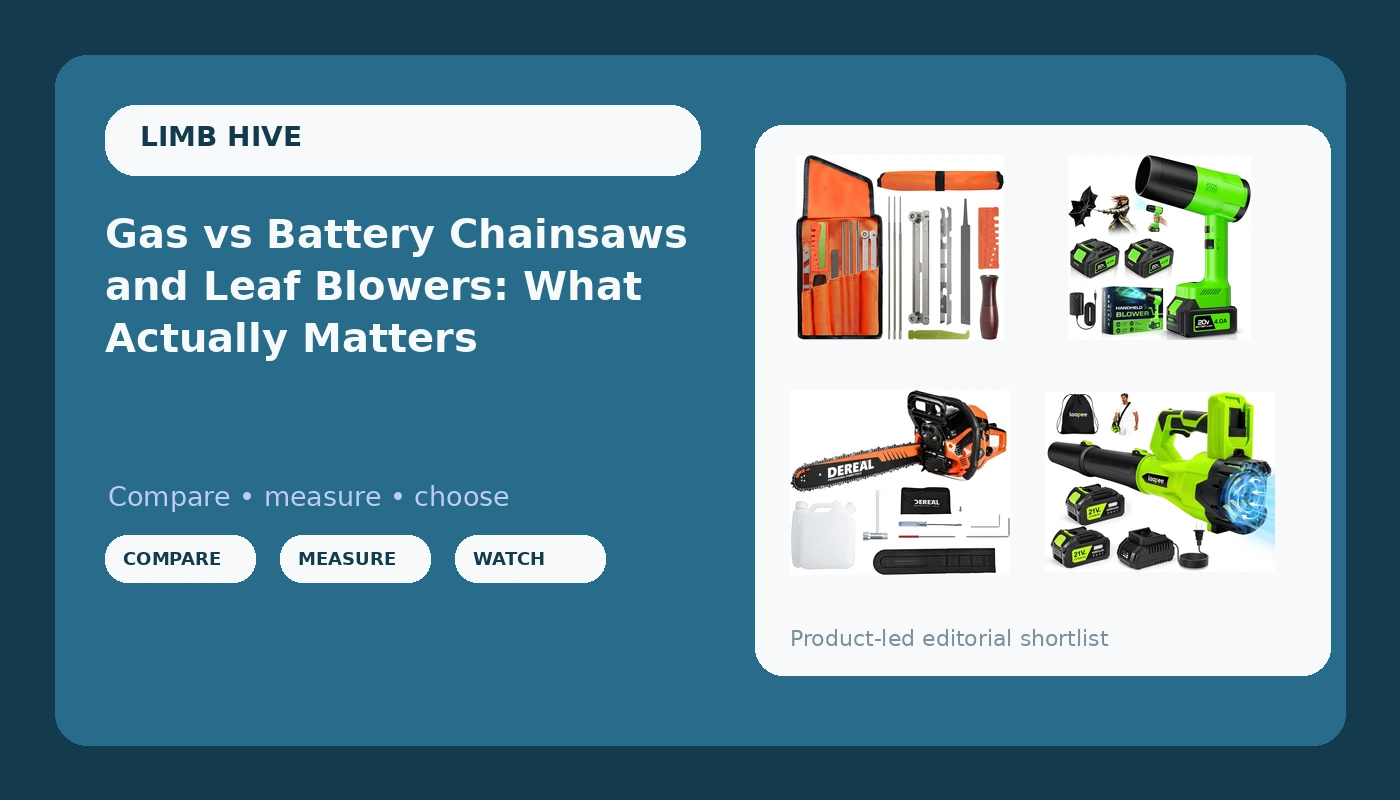
A saw that will not start at 6 a.m. in cold rain is not a saw. It is a paperweight with a pull cord. That one test settles more buying arguments than any spec sheet, and it is why this guide mixes a 20-inch gas saw, two cordless blowers with very different priorities, and a ten-piece file kit instead of lining up four machines that pretend to do the same job.
If you are weighing gas vs battery chainsaws for your own property, both belong in the conversation. Gas still owns big wood, long days, and storm calls where the truck cannot wait on a charger. Battery owns the easy work: limbing, trimming, clearing a driveway, and any job where you would rather not pull a cord. The mistake is buying one and expecting it to cover the other.
What follows is a short list that covers the whole arc of a yard or storm cleanup, from the first cut to the last pass over the concrete, with the trade-offs stated plainly.
Related: Chainsaw Chain Sharpening: How to Keep a Saw Cutting Straight →
Quick answer
If you cut firewood, drop medium trees, or clear storm damage, gas is the answer, because the tool keeps running while a battery sits on a charger. The 20-inch, 62cc gas chainsaw below is the pick in this group for that work. If your cutting is limited to limbs, brush, and the occasional downed branch, a cordless saw on a battery platform you already own will do the job with less fuss, and the money you save belongs in the chain, not the motor.
For cleanup, CFM is the number that matters. A cordless blower rated at 650 CFM with two 4.0Ah batteries and a fast charger is aimed at people who want gas-like airflow without the fuel can. A lighter six-speed cordless blower is aimed at driveways, patios, walkways, and light snow. Either way, the ten-piece file kit is the cheapest way to keep whatever saw you own cutting the way it should.
Nothing here gets called the best, because the right answer depends on what you cut, how often you cut it, and what batteries are already in your garage.
Four useful options
| Model | Best fit | What stands out |
|---|---|---|
| Gas Chainsaws 20 Inch Gas Powered Chainsaw 62CC CS62X-FO 2 Stroke Engine Chain Saw for Cutting Wood Outdoor Garden Farm Home | Storm debris and firewood | 62cc two-stroke engine on a 20-inch bar |
| Leaf Blower Cordless 650CFM with 2x4.0Ah Battery Powered and Fast Charger | Driveways and wet leaves | 650 CFM rating, two 4.0Ah batteries, fast charger |
| Leaf Blower Cordless, Handheld Leaf Blower with 2 X 4.0Ah Battery and Charger, Snow Blower with 6 Speed Modes, Lightweight Blowers for Lawn Care, Patio, Yard, Blowing Snow, Leaves, Dust | Walkways, patios, light snow | Six speed modes, two 4.0Ah batteries and a charger |
| 10-Piece Chainsaw Sharpening Kit, 5/32, 3/16 and 7/32 Inch | Any saw owner | Three file sizes covering common chain pitches |
The storm saw: Gas Chainsaws 20 Inch Gas Powered Chainsaw 62CC CS62X-FO 2 Stroke Engine Chain Saw for Cutting Wood Outdoor Garden Farm Home
Here is the honest trade-off with any gas saw. You gain unlimited runtime and you pay for it in maintenance. A two-stroke needs mixed fuel at the right ratio, a clean air filter, a spark plug that is not fouled, and a carburetor that behaves when the temperature drops. Leave ethanol fuel sitting in the tank through the off-season and the first warm Saturday of spring goes to a carburetor instead of a woodpile.
The other trade-off is size. A 62cc engine on a 20-inch bar is a real saw, and real saws are heavy, loud, and unforgiving of sloppy technique. If your wood is mostly four-inch limbs, you are carrying a lot of machine for the job. If your wood is a maple that came down across the driveway, this is the class of tool that gets it off the pavement.
The high-output cordless blower: Leaf Blower Cordless 650CFM with 2x4.0Ah Battery Powered and Fast Charger
Airflow is the number to shop by, not speed. Blowers advertised in miles per hour are selling a velocity figure that looks impressive on a box and says very little about how much debris leaves the pavement. CFM, cubic feet per minute, is the volume of air the tool moves, and volume is what pushes a mat of wet leaves down a driveway instead of flipping the top layer.
The catch with any cordless blower is runtime at full blast. CFM gets rated at the highest setting, and the highest setting empties a battery fastest. Two 4.0Ah batteries and a fast charger soften that problem considerably, since you can work on one pack while the other charges. That beats a single battery and a wall charger that only handles one pack at a time. Weight is the other factor, because a handheld blower carrying a 4.0Ah pack feels heavier in the hand than the bare tool on the spec sheet suggests.
The light-duty cordless blower: Leaf Blower Cordless, Handheld Leaf Blower with 2 X 4.0Ah Battery and Charger, Snow Blower with 6 Speed Modes, Lightweight Blowers for Lawn Care, Patio, Yard, Blowing Snow, Leaves, Dust
Six speed modes matter more than they sound. Full blast is for wet leaves and open pavement. The lower settings handle the jobs where full power is the wrong tool: pollen strands on a walkway, grass clippings on a pool deck, dust on a patio, and light snow. Anyone who has blasted a flowerbed at full throttle and then spent twenty minutes raking mulch off the lawn understands why a speed dial earns its place.
The snow claim deserves a careful read. A cordless handheld can move an inch or two of powder off a walkway or a car. It is not a substitute for a two-stage snow blower after a real storm, and no handheld blower is. Buy it for leaves, dust, and light snow and it will do what you ask. Ask it to clear a long driveway of wet snow and you will be disappointed.
The chain keeper: 10-Piece Chainsaw Sharpening Kit, 5/32, 3/16 and 7/32 Inch
The chain is the saw. A sharp chain on a modest saw outcuts a dull chain on an expensive one every single time, and the difference shows up first in wet wood, where dull cutters ride on the surface instead of pulling a chip. Most people who decide their saw is underpowered are actually running a chain that needed five minutes with a file two tanks of fuel ago.
The three file sizes in this kit line up with the chain pitches most saws use. The 5/32 file covers low-profile 3/8 pitch chain, the 3/16 file covers .325 pitch, and the 7/32 file covers full 3/8 pitch. Match the file to the pitch marked on your bar or your chain, hold the file at the angle the tooth already has, and count strokes so both sides stay even. A few passes per tooth every tank of fuel keeps a chain cutting. Waiting until it stops cutting means grinding away a lot of metal to get it back.
Prices and availability may change. Product images, names, and retailer links are matched to verified listings. No current price, rating, stock status, or measured result is stated here without current evidence.
Gas and battery are not competing for the same job
The argument about gas vs battery chainsaws usually misses the point, because the two power sources fail in opposite directions. A gas saw fails when it is neglected: stale fuel, a dirty filter, a fouled plug, a carburetor that will not idle in the cold. A battery saw fails when the charge runs out, and no amount of maintenance buys you another hour of cutting.
That shapes what each tool is good at. Gas wins on big wood, long sessions, and any job where you cannot stop and wait. It also brings noise, exhaust, mixed fuel, and a seasonal maintenance routine. Battery wins on instant starts, zero fuel handling, and light duty work where the job is measured in minutes rather than hours. Cold weather works against battery packs, which is worth knowing before you count on one for a January storm.
The question nobody asks until it is too late is the platform. A cordless tool is only as good as the batteries you can keep feeding it, and a pack that fits nothing else you own turns one tool into an orphan. Replacement packs can cost a large fraction of what the whole tool cost. Before you buy any cordless blower or saw, check whether that battery line covers the trimmer, the drill, or the mower you already own. If it does not, price the spare pack into the decision.
Reading the numbers on the box
Three numbers decide most of these purchases, and two of them are routinely misunderstood.
CFM versus mph comes first. Miles per hour describes how fast air leaves the nozzle. CFM describes how much air leaves it. Leaves and wet debris respond to volume, so a blower with a big mph number and modest CFM will scatter dry leaves and struggle with anything stuck to the ground.
Bar length versus engine size comes second. A 20-inch bar on a 62cc engine is a matched pair. A long bar on a small engine bogs in the cut and wears the powerhead out early, which is why a saw advertised with a big bar and a small displacement deserves a second look.
File size versus chain pitch comes third. Sharpening the wrong pitch with the wrong file rounds the cutter over instead of restoring an edge, and a chain that has been filed badly cuts worse than the dull one you started with.
- Measure the biggest thing you actually cut, not the biggest thing you might cut someday.
- Time your typical job honestly, then ask whether a battery pack covers it at full output.
- Check what other tools share the battery platform before you commit to a cordless tool.
- Budget for the chain and the files, not just the powerhead.
- Read the warranty card in the box before you read the price tag.
Storm-season habits that save the gear
- Mix only as much fuel as you will burn in a few weeks, and run the saw dry before it goes into storage.
- Sharpen before the job, not during it. A few strokes every tank beats an hour of filing on a downed tree.
- Keep batteries indoors and charge both packs the night before a storm warning, not the morning of.
- Test the cold start in the driveway before you need the saw on a roof or in a ditch.
- Wear chaps and eye protection every time, including the quick cuts that feel too small to matter.
Which option should you choose?
Choose the Gas Chainsaws 20 Inch Gas Powered Chainsaw 62CC CS62X-FO 2 Stroke Engine Chain Saw for Cutting Wood Outdoor Garden Farm Home when your wood is large, your sessions are long, and a dead battery mid-cut is not an option. Choose the Leaf Blower Cordless 650CFM with 2x4.0Ah Battery Powered and Fast Charger when you are fighting wet leaves on a driveway or a parking pad and want the most airflow per pass. Choose the Leaf Blower Cordless, Handheld Leaf Blower with 2 X 4.0Ah Battery and Charger, Snow Blower with 6 Speed Modes, Lightweight Blowers for Lawn Care, Patio, Yard, Blowing Snow, Leaves, Dust when your cleanup is walkways, patios, beds, and light snow, and you want a lighter tool with speed control. And add the 10-Piece Chainsaw Sharpening Kit, 5/32, 3/16 and 7/32 Inch regardless of which saw you run.
One caveat worth repeating: none of these listings states a runtime, a tested airflow figure, or a warranty term in the product name, and those are the details that decide whether a tool works for you. Confirm the specs, the included accessories, and the warranty terms on the listing itself before you buy.
The bottom line
Gas and battery are not rivals here. They cover different halves of the same season. A 62cc gas saw with a 20-inch bar handles the wood that shows up after a storm, a 650 CFM cordless blower with two packs and a fast charger handles the debris that follows, a six-speed handheld covers the lighter cleanup around the house, and a ten-piece file kit keeps the chain on any saw pulling chips instead of dust. Buy the power source that matches your workload, check the battery platform before you commit, and put the first money into the chain.