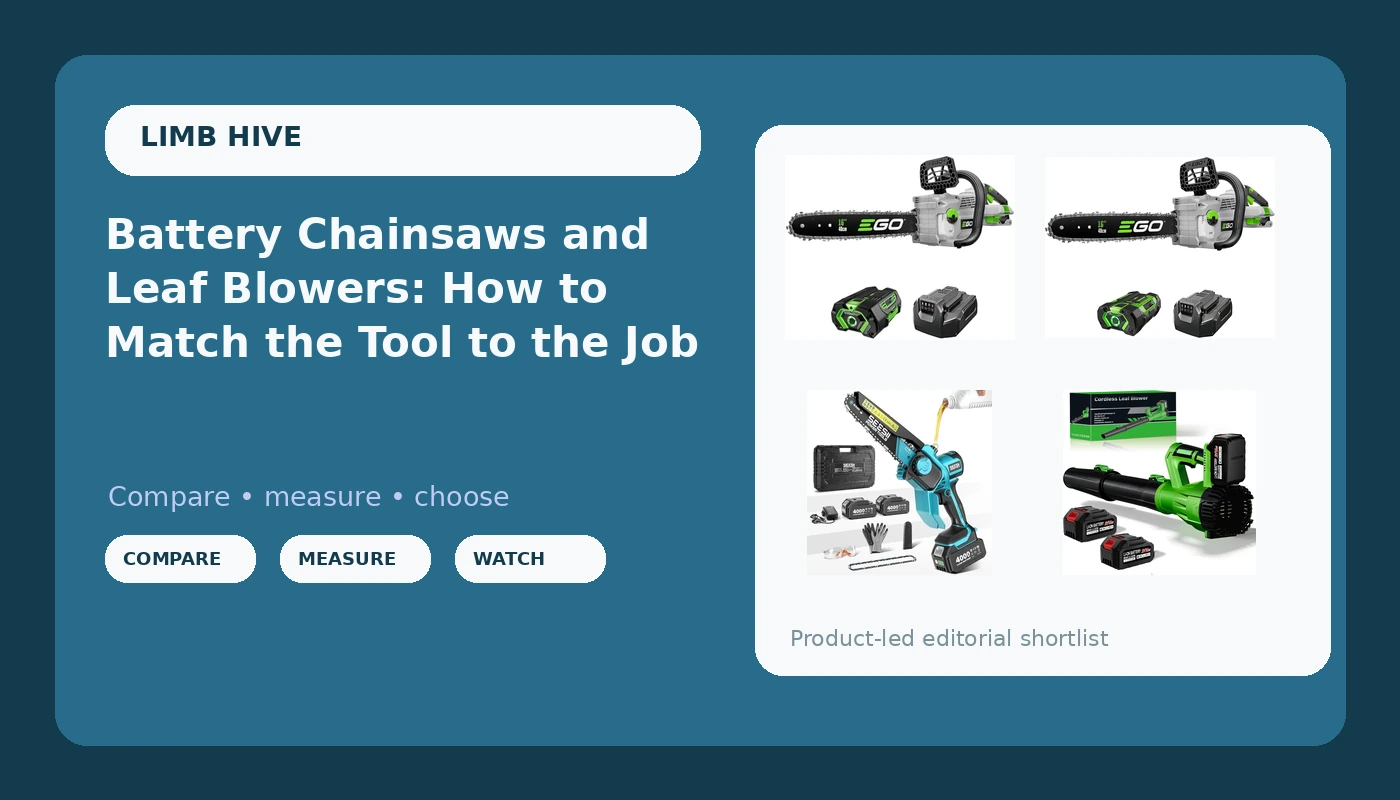
Battery chainsaw and leaf blower shopping looks simple until you are standing in front of four listings that all promise cordless convenience and none of them tell you what happens on the third wet limb. The real question is not which tool is best in some absolute sense. It is which tool fits the work you actually do, the batteries you already own, and the size of the wood and debris sitting in front of you. This explainer sorts four cordless options: two 16-inch EGO POWER+ saws that differ mainly in the battery that comes in the box, an 8-inch brushless mini chainsaw built for limbs, and a 21V handheld blower that ships with two 6.0Ah batteries. The goal is to get you to the right one without paying for capacity you will never use.
Related: Gas vs Battery Chainsaws for Storm Cleanup →
Quick answer
Match bar length and battery capacity to the job instead of to the biggest number on the page. A 16-inch cordless saw with a 56V 4.0Ah battery is the more flexible pick when you cut firewood-sized limbs and want more run time between charges. The same saw with a 2.5Ah pack trades run time for a lighter battery. An 8-inch mini saw is a limb and pruning tool, not a felling saw. A 21V handheld blower with two batteries in the box is a hard-surface tool for driveways, decks, and walkways. None of these four replaces a gas saw for storm work on big wood, and none of them should be judged by a runtime number printed on a box.
Four useful options
| Model | Best fit | What stands out |
|---|---|---|
| EGO POWER+ Chain Saw, 16” Battery Powered Chainsaw, Electric Cordless, Includes 56V 4.0Ah Battery and Charger, CS1613 | Cutting firewood-sized limbs and small trunks where run time per charge matters | 16-inch cordless saw paired with the larger 4.0Ah 56V battery and a charger |
| EGO POWER+ Chain Saw, 16” Battery Powered Chainsaw, Electric Cordless, Includes 56V 2.5Ah Battery and Charger, CS1611 | Trimming and light cutting where a lighter pack beats extra capacity | Same 16-inch cordless saw format with a 2.5Ah 56V battery and charger |
| SEESII Flagship 8-Inch Cordless Mini Chainsaw, Upgraded Brushless Motor | Limbs, pruning, and tight-quarters work where a compact bar reaches | 8-inch bar and a brushless motor in a small cordless body |
| 21V Cordless Leaf Blower with 2 Pack 6.0Ah Batteries, Black Green | Driveways, decks, walkways, and dry debris on hard surfaces | Ships with two 6.0Ah batteries so one can charge while the other works |
The flexible 16-inch pick: EGO POWER+ CS1613
The trade-off with this one is weight and money. A 4.0Ah pack is heavier on the saw than a 2.5Ah pack, and it costs more to buy. What you get for that is more time between battery swaps, which is the number that actually decides whether a cordless saw finishes a job. If you already run EGO 56V tools, the pack is shared across the line, and that is the whole argument for staying inside one platform. If you cut six limbs a year off a maple, you are paying for run time you will not use, and the smaller-battery version below makes more sense.
The lighter 16-inch pick: EGO POWER+ CS1611
Here is the part people get wrong about these two saws. They are not different classes of saw. They are the same 16-inch cordless saw with a different battery decision attached, and the battery is the decision that changes how the day goes. A 2.5Ah pack on a 56V platform gives you less cutting per charge than a 4.0Ah pack, full stop. If your work is storm cleanup and long sessions, buy the bigger pack. If your work is trimming the shrubs at the end of the driveway and cutting up one fallen branch, this version keeps the cost down and the saw lighter in your hands, which matters by the end of an afternoon.
The limb saw: SEESII 8-Inch Cordless Mini Chainsaw
An 8-inch bar sets a hard ceiling on what this saw can cut, and that ceiling is the point. It is a limb saw. It is not a felling saw, it is not a firewood saw, and it is not the tool you reach for when a tree is on a roof. What it does well is the work that eats an afternoon: sucker growth, low branches, storm-twisted limbs you can reach from the ground, and cuts in tight corners where a 16-inch bar has no room to move. The trade-off is that small bars and one-handed use put your hands closer to the cut, so chaps, eye protection, and a firm grip stop being optional. Treat it as a precision tool and it earns its place in the truck.
The hard-surface blower: 21V Cordless Leaf Blower
Two batteries in the box is the detail that makes a budget blower usable. One pack runs while the other charges, which removes the wall-wart problem of standing around waiting for a single battery to come back up. The limit is the class of tool. A handheld 21V blower moves dry leaves, grass clippings, pollen strands, and dust off pavement. Ask it to clear an acre of wet oak leaves and you will be disappointed, and that is not a knock on the tool, it is a mismatch. Buy it for the driveway, the pool deck, and the walkway, and it does the job it was built for.
Prices and availability may change. Product images, names, and retailer links are matched to verified listings. No current price, rating, stock status, or measured result is stated here without current evidence.
What bar length and voltage actually tell you
Bar length is a limit, not a power rating. A 16-inch bar means the saw can carry a 16-inch chain, and in practice it handles limbs and small trunks in that neighborhood. An 8-inch bar means limbs and pruning cuts, and pushing past that stalls the chain and heats the bar. Manufacturers print the bar length in large type because it is the number shoppers recognize, but the number that decides whether you finish the job is how much cutting you get per charge.
Voltage is a platform label, not a muscle measurement. A 56V EGO pack and a 21V pack are not directly comparable by voltage alone, because motor design, gearing, and chain speed all change the result. What voltage does tell you is which family of batteries and chargers you are joining. That matters more than most buyers expect, because a battery that fits only one tool is the most expensive part of the purchase.
Amp-hours are capacity, and capacity is time. On the same platform, a 4.0Ah pack holds more energy than a 2.5Ah pack, which translates into more cutting or blowing per charge. It also translates into more weight in your hand. That is the entire trade between the two EGO saws above, and it is the trade most people should be thinking about instead of comparing brand names.
Why runtime and airflow claims deserve a stopwatch
Runtime claims are written by marketing departments, and the test conditions rarely match your yard. A saw that runs 40 minutes in a lab cutting dry pine may run half that in wet hardwood with a chain that needs filing. The honest way to compare two battery tools is to time them yourself on the material you actually cut, from a full charge, at the speed you actually run them. If you cannot test before buying, treat any runtime figure as an optimistic ceiling and buy capacity accordingly.
Airflow claims have the same problem. Cubic feet per minute is the number that moves debris. Miles per hour is a speed figure that sounds impressive and tells you almost nothing about whether the air stream has enough volume to push a pile of wet leaves down a driveway. When a listing leans hard on mph, look for CFM, and if it is not there, treat the airflow claim as unverified.
Wet material is the honest test for both tools. A blower that clears dry leaves can still fail on wet ones, and a saw that zips through a dry pine limb can bog in soaked hardwood. Whatever you buy, plan on the wet day being the one that reveals whether you chose well.
A five-step way to sort these tools before you buy:
- Write down the largest thing you actually cut or clear in a normal year, not the largest thing you imagine cutting.
- Decide whether you are joining a battery platform, and check what else that platform powers before you commit.
- Compare what is in the box, including amp-hours and whether the charger handles one battery or two.
- Plan for wet material, since that is the condition that separates adequate tools from frustrating ones.
- Check the warranty terms and confirm the card is actually in the box before the return window closes.
Matching the tool to the job
- Use a 16-inch cordless saw for limbs and small trunks, and keep a gas saw for the big storm wood that cordless cannot finish.
- Use an 8-inch mini saw for pruning, sucker growth, and tight cuts, and keep both hands on it whenever the bar is in wood.
- Use a handheld 21V blower for pavement, decks, and walkways, and accept that a large wet-leaf yard is a different class of job.
- Wear chaps, eye protection, and hearing protection every time the chain is moving, no matter how short the cut looks.
- Keep the chain sharp and the bar oil full, because a sharp chain on a modest saw outperforms a dull chain on an expensive one.
Which option should you choose?
Choose the EGO POWER+ 16” Chain Saw with the 56V 4.0Ah battery and charger when you cut firewood-sized limbs and small trunks and want more time between battery swaps. Choose the EGO POWER+ 16” Chain Saw with the 56V 2.5Ah battery and charger when your cutting is occasional trimming and you would rather carry a lighter pack and spend less. Choose the SEESII Flagship 8-Inch Cordless Mini Chainsaw when your work is limbs, pruning, and tight spots that a full-size bar cannot reach. Choose the 21V Cordless Leaf Blower with two 6.0Ah batteries when you need to clear driveways, decks, and walkways and want a spare battery on hand while the first one charges.
One caveat on all four: the specs here describe the tools and what comes in the box. They do not tell you how the battery performs in your climate after two seasons, how the chain holds up in wet hardwood, or whether the platform will still sell compatible packs in five years. Those are the questions that decide long-term value, and they get answered by owner reports and warranty paperwork, not by a listing page. Read the fine print before you check out.
The bottom line
Cordless saws and blowers have gotten good enough to handle light-duty work that used to require gas, and the four tools here cover the common cases: two 16-inch saws that differ by battery capacity, a compact limb saw, and a handheld blower with a spare battery in the box. The deciding factors are simple. Match the bar to the wood, match the amp-hours to the session length, and confirm the battery fits something else you own or plan to own. Get those three right and any of these tools will do the job it was built for. Get them wrong and you will own a paperweight with a charger attached.