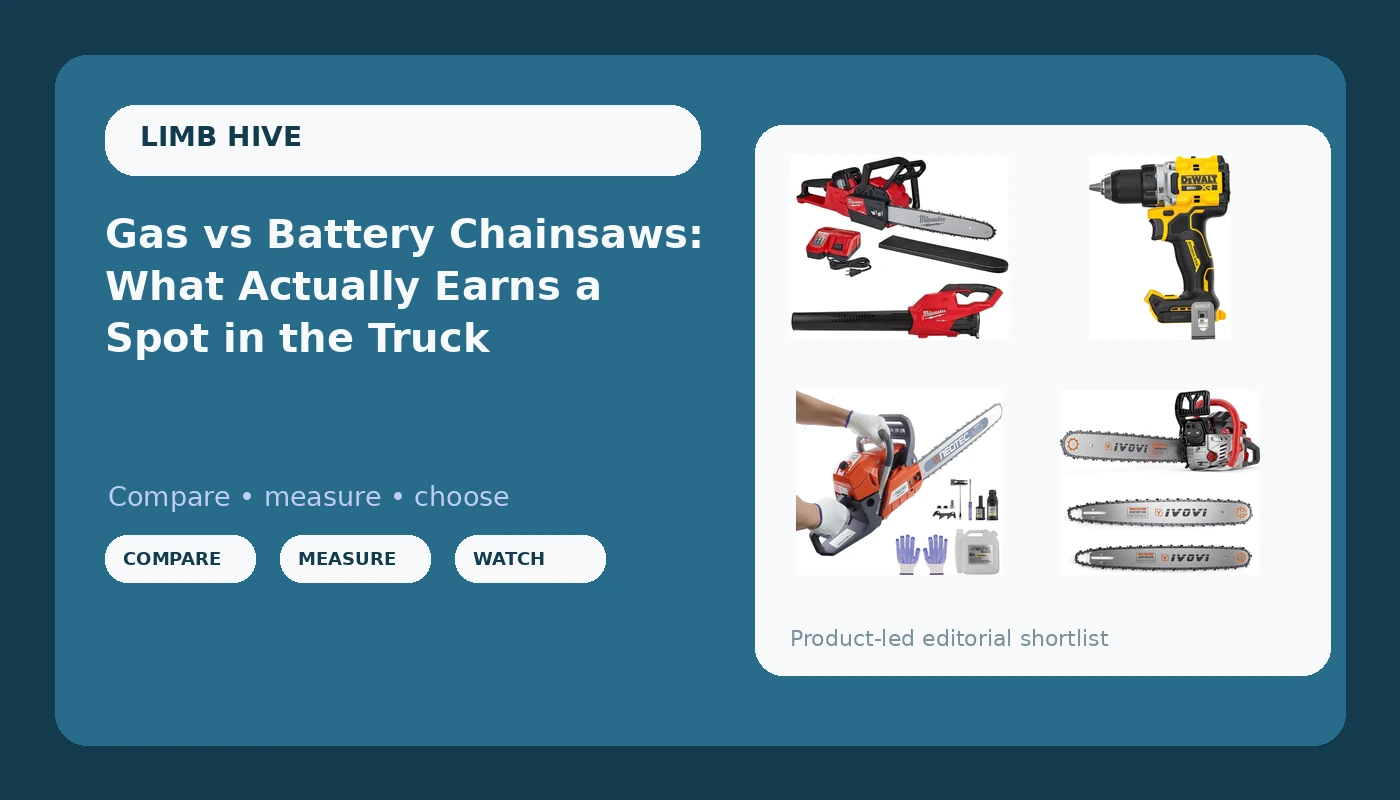
Twelve years running a tree crew outside Charlotte taught me one thing about saws: the box is a sales pitch and the tree is the exam. The exam happens at 6 a.m. in cold rain, with a maple folded over somebody's driveway and the homeowner watching from the porch. That is the frame I use whenever I compare gas vs battery chainsaws, because a saw that quits mid-cut is not a tool. It is a problem you now have to solve with your hands.
I have been burned by two things in this category. The first was a cheap saw that vibrated my hands numb and wanted a carburetor rebuild every other season. The second was a battery platform that looked like a bargain until I priced a replacement pack and found it cost about half of what a whole new tool costs. Both lessons are baked into this comparison. Four tools are in front of me: two gas saws, one battery saw that ships as a kit with a blower, and one cordless drill/driver. The drill is not a mistake. It is the battery platform question in physical form, and it decides more of this comparison than any spec line does.
The short answer: for storm debris and firewood a few times a year, a 58cc gas saw with an 18 or 20 inch bar is the value pick. For anyone already running M18 batteries, the Milwaukee kit is the one to beat. If your truck is already on DEWALT 20V MAX, do not buy a cordless saw from a different brand just to save money on the sticker, because the battery is the real cost.
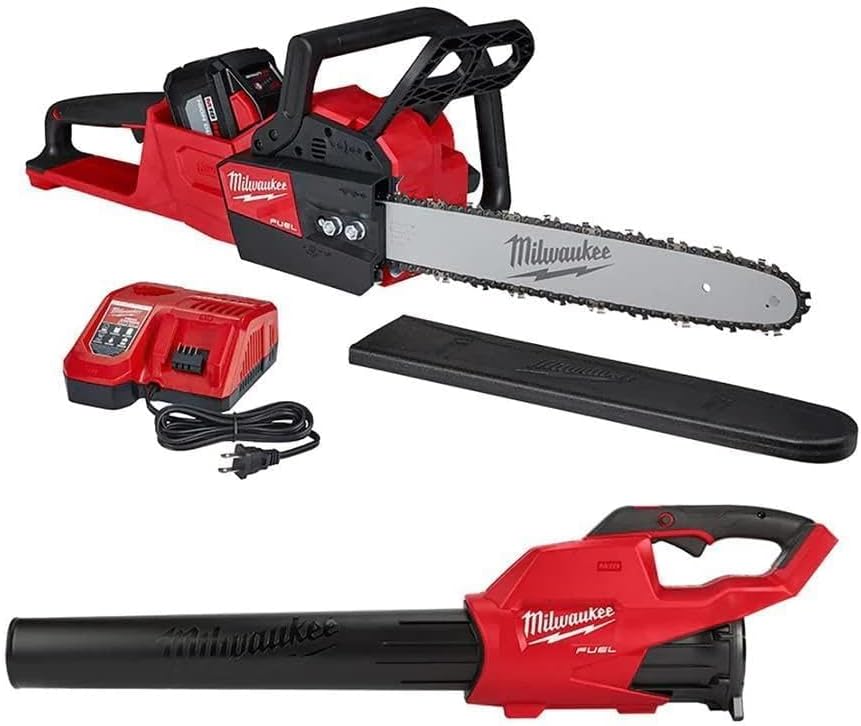
Milwaukee 2727-21HDP M18 Fuel 16 in. Chainsaw with Free Blower Kit
The most complete answer to "clear the driveway without pulling a rope." No mix, no choke, no carb sitting through winter, and the blower comes in the same box
Juice is the catch, not power. A 16 inch bar is a limb and cleanup bar, and one pack plus a one-battery charger will leave you standing around mid-job
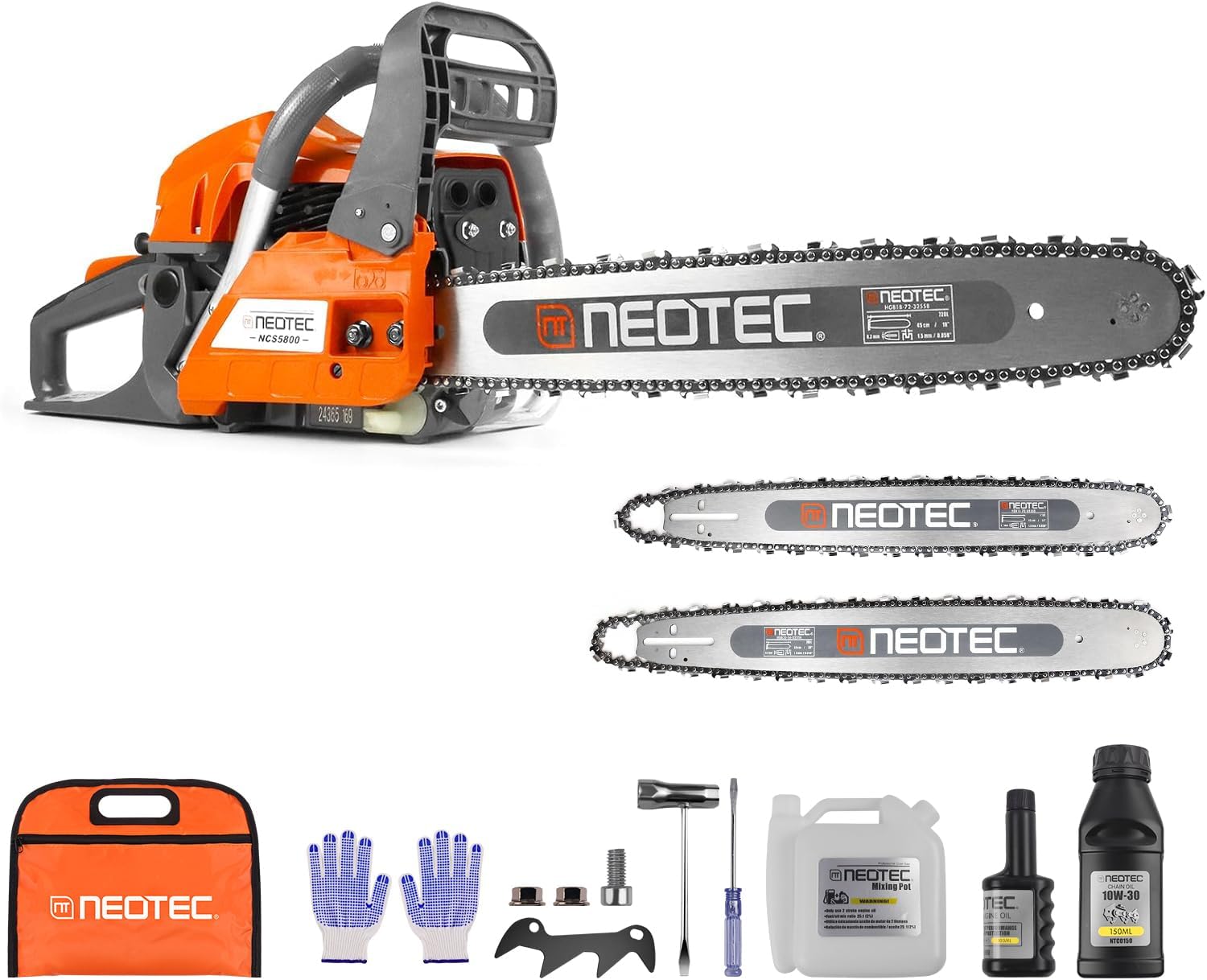
58CC Gas Powered Chainsaw 18 20 Inch Bars Chain Ergonomic Chainsaw Chain Brake Anti-Vibration System, 2-Cycle Petrol Motosierra De Gasolina for Tree Cutting Firewood Wood Yard Cleaning
Two bar lengths in one box, plus a chain brake and anti-vibration listed. This is the shape of a saw a homeowner can actually learn on
Gas means a morning ritual: mixing fuel, cold pulls, and a saw that may not want to idle when it is wet and cold
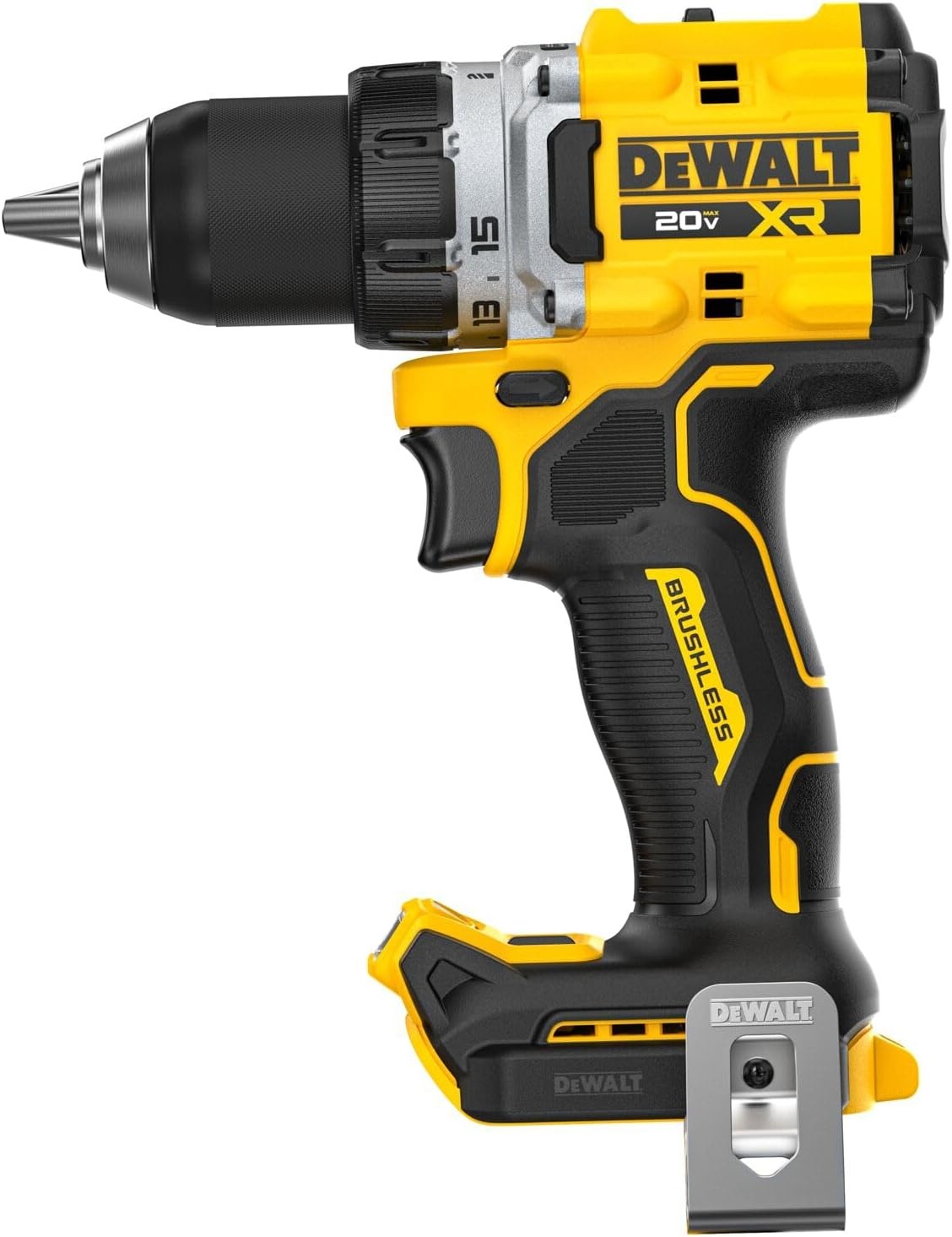
DEWALT 20V MAX XR Brushless Cordless 1/2 in. Drill/Driver (Tool Only) (DCD801B)
The platform anchor. If 20V MAX packs are already in your truck, a cordless saw that shares them is a completely different purchase
Tool only, no battery or charger, and it is a drill, not a saw. It earns its place here as a platform check, not as cutting gear
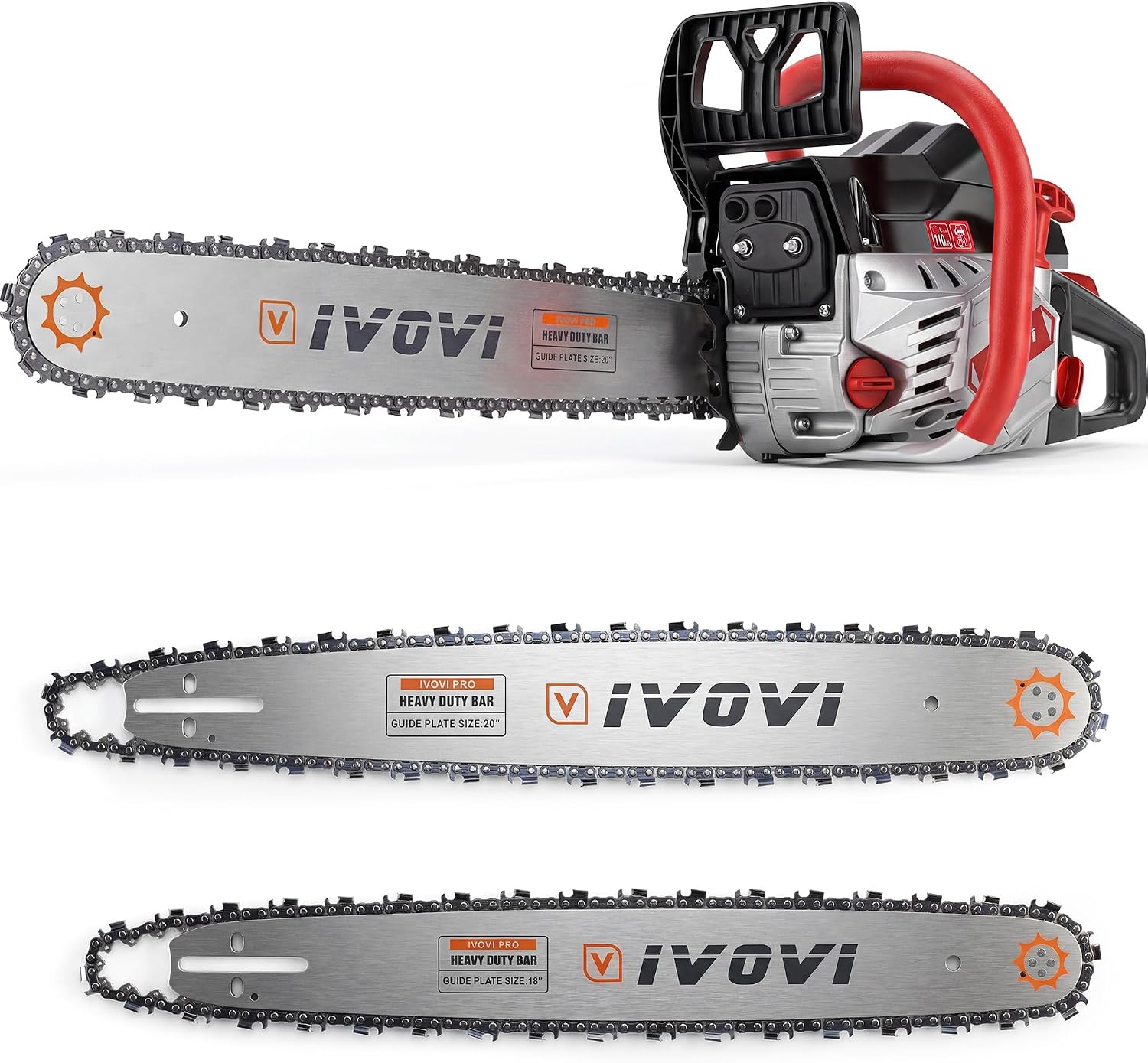
63CC Gas Chainsaw with 20-Inch and 18-Inch Bars
The most displacement here, and two bars means limbing and bucking without buying a second bar. This is the storm-debris setup
Weight and fuel appetite. More saw than a suburban homeowner trimming twice a year will ever need
Prices and availability were captured from Amazon Creators API and may change.
What the Milwaukee kit is actually for
An M18 Fuel saw with a 16 inch bar, bundled with a blower in the same box, is the cleanest answer for the person who wants to clear a driveway after a storm and never touch a pull cord. No fuel to mix, no choke, no carburetor sitting all winter with stale mix in it. For limb work, cleanup, and small take-downs, that is a real advantage, and the blower being in the kit means one purchase covers the debris side of the job too.
The catch is never the first ten minutes of cutting. It is the eleventh minute of the second hour. If you buy into this kit, budget for a second pack and a charger that fills more than one battery at a time, because the brick-style charger that only does one pack will have you watching grass grow while the tree is still on the ground. I do not print runtime numbers I have not timed myself with a stopwatch from a full charge, and a number on a box is not that.
Also worth saying plainly: a 16 inch bar is a limb and cleanup bar. It is not the saw for a 24 inch trunk. No marketing copy is going to tell you that, but the tree will.
The 58cc gas saw: the value pick
A 58cc two-cycle saw that ships with both an 18 and a 20 inch bar is the shape of a saw I understand. The listing also names a chain brake and an anti-vibration system, and those two features matter more than any horsepower claim printed on a box. The chain brake is the kickback safety, and anti-vibration is what decides whether your hands are still useful after an hour of cutting. I would run the 18 inch bar most of the day and bring out the 20 when the wood gets bigger and reach matters more than speed.
What you give up with gas is the ritual. Mixing fuel, pulling a cold saw, listening to whether it wants to idle. A saw that will not idle right in cold weather is usually a fuel problem, not a brand problem, but that is cold comfort when the clock is running and the homeowner is watching. Gas also means maintenance you cannot skip: fresh mix, a clean air filter, and a chain you actually file. Do those three things and a 58cc saw will out-cut and out-last any battery tool in this price range on a long storm day.
For a homeowner cutting fallen limbs twice a year, this is the sensible middle. It is not a pro saw, and it does not need to be. A solid mid-size gas saw that starts and holds an idle will finish the job, and finishing the job is the whole point.
The 63cc saw with two bars: the storm option
Displacement is not a marketing number when a bar is buried in wet wood. That is where a 63cc saw separates itself from the smaller gas saw here: more engine to pull a chain through green wood and knots without bogging down. The two-bar setup is the part I like most. Run the 18 inch bar for limbing and cleanup, then swap to the 20 inch bar for bucking trunk sections, all without buying a second bar.
The trade-off is honest and simple. Bigger displacement means more weight in your hands and more fuel through the tank. If your cutting is a few storm limbs and a cord of firewood a year, this is more saw than you need, and you will feel that extra weight by the end of an afternoon. If your version of a Saturday is bucking up a downed oak so the driveway is passable by Monday, this is the one of the three saws here that was built for that day.
Why a DEWALT drill is in a chainsaw comparison
The DEWALT 20V MAX XR brushless drill/driver is tool only, meaning no battery and no charger in the box, and it is obviously not a saw. It belongs here because it answers the question that comes up in every battery saw conversation I have: what else does the pack fit? If you already own 20V MAX batteries, a cordless saw that shares them is a fundamentally different purchase than a saw with a proprietary pack and a charger you will use for exactly one tool.
The drill itself is the kind of half-inch brushless unit that lives in a truck box for driving lag bolts into a temporary tarp frame after a storm, which is exactly the job I ask a drill to do. Judge it here as the platform anchor, not as cutting gear. If your honest answer is "I own nothing on that platform," then the DEWALT route is a dead end for you, and a battery saw from another brand is not automatically the wrong call. One platform or it is a paperweight is a rule I actually follow, and it has saved me more money than any sale price ever has.
The chain is the saw
A sharp chain on a $150 saw beats a dull chain on a $900 saw, and I will argue that with anyone who wants to. Every saw in this comparison ships with a chain, and the first thing I do with any new saw is inspect it, because factory chains arrive dull more often than anyone admits. Learn to file: ten strokes on each tooth, keep the rakers right, and touch it up every tank of fuel. That single habit does more for your cutting speed than any upgrade on this list.
The rest is safety gear, and it is not optional. Chaps, eye protection, hearing protection. Kickback is the saw's way of reminding you it does not care how confident you are: the nose of the bar bites, and the bar comes up toward your face. Every pro I know wears chaps anyway, including the ones who have been cutting thirty years. The saw does not know how long you have been doing this.
The trade-offs the spec sheets skip
- Cold start. Gas needs a ritual and a little patience, and a neglected carb will punish you on the coldest morning of the year. Battery wins this one outright if the pack is charged and not frozen.
- Runtime. A battery saw runs out mid-job and you stop. A gas saw refuels in two minutes from a can in the truck. On storm work, that difference is the whole ballgame.
- Maintenance. Gas wants mix, filters, and carburetor attention. Battery wants nothing until the pack dies, and then the pack is the cost.
- Storage. A battery saw can sit in a truck bed all winter and be fine. A gas saw with old mix in it will not forgive you.
- Noise and fumes. Battery for the porch, the garage, and the neighborhood. Gas for the back acre where nobody is listening.
- Longevity. A well-kept gas saw is a decade tool. A battery saw's working life is tied to a platform that will change under you, which is exactly why the pack question comes first.
Which one I would hand to whom
- You already run M18 batteries and want one kit for saw plus cleanup: the Milwaukee M18 Fuel 16 in. saw with the blower kit. Check current Amazon price and make sure you have a second pack.
- You own no battery platform, have a big yard, and cut firewood: the 58cc gas saw with the 18 and 20 inch bars. Learn to file the chain and it will serve you for years.
- You take storm calls or buck real wood: the 63cc gas saw with both bars. Displacement is what gets a buried bar out of wet wood.
- You are already on DEWALT 20V MAX: start with the drill/driver as your platform anchor, then buy a saw that shares those packs. Do not split your batteries across two brands to chase a sticker price.
What I am watching next
Battery saws keep getting better, and I keep timing them instead of trusting the box. What I want before I move a cordless saw into the storm rotation is a full season of cold mornings, wet wood, and honest stopwatch numbers, plus a charger that fills more than one pack at a time. Until a battery saw clears that bar, the gas saws stay in the truck, and the cordless kit stays what it is: the right tool for the easy stuff, the trim work, and the driveway at the end of the day.