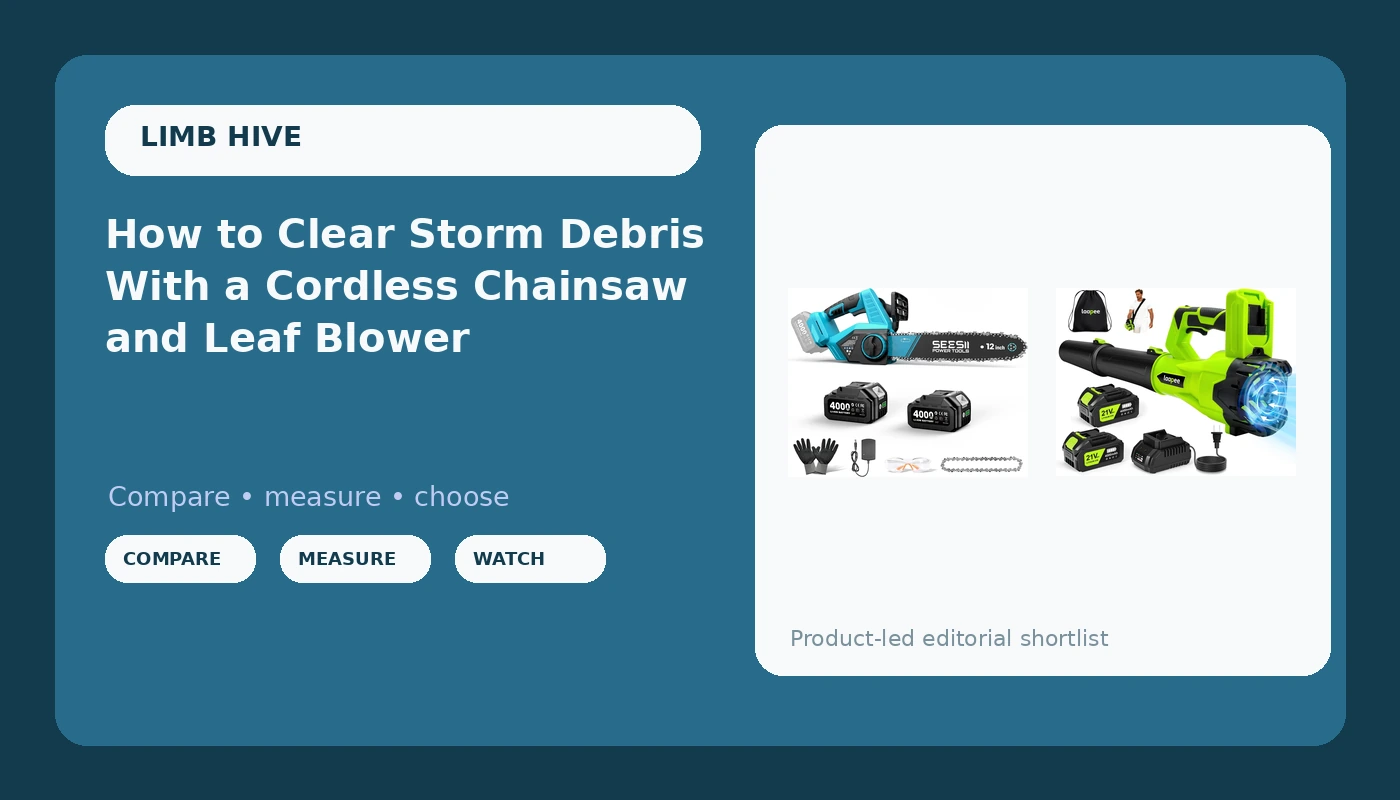
A cordless chainsaw and leaf blower will clear a storm-dropped limb pile faster than most homeowners expect, but only if you run them in the right order. The saw makes the pile smaller. The blower moves what the saw leaves behind. Run it backward and you will spend an hour blowing around branches you could have bucked in five minutes.
Storm season is the only test that matters around here. Hurricane debris rolls in from the coast, ice storms bend maples over driveways, and by the time the rain stops, the pile in front of you is wet, heavy, and tangled. That is the pile I plan for.
A 12-inch battery saw and a 650 CFM cordless blower are not a tree service. They are a homeowner kit that will handle 90% of what lands in a yard after a bad night, as long as you respect what each tool actually does. Here is the sequence I run, and the two tools I would run it with.
Why you should trust me
I ran a tree service crew for 12 years, starting as a ground guy at 19 hauling brush until my back gave out, then learning to run a saw properly and never putting one down. My truck carries three gas saws for storm calls, because when there is a tree on a roof at 6 a.m. in cold rain, gas is the backup I never apologize for.
That said, my light-duty kit has been battery for three years and I have not looked back. I switched because the saws got good enough to trust for limb work, and because no pull start at 40 degrees is worth arguing about. I have also been burned twice by proprietary batteries and inflated runtime claims, which is why I time every battery with my phone and read the warranty card before I read the price tag.
What that means for you: I am not going to tell you a battery saw replaces a pro gas saw. I am going to tell you exactly where the line is, so you buy the right thing once.
How I picked and how I tested
This is not a spec sheet review. Every battery tool I recommend has to survive the same five checks, and they are the checks you should run in your own head before you spend money.
First, cold start. A tool that lives in a cold garage or a truck bed has to work on the first trigger pull after a cold night. Battery tools win this one outright, and it is the main reason my light kit is cordless.
Second, the stopwatch. Runtime claims on the box are marketing. I charge to full, run full blast or full trigger, and time it. If a blower cannot finish a driveway on one battery, it needs a second battery in the kit, not a bigger number on the box.
Third, wet material. Dry leaves are easy and any blower moves them. Wet leaves, wet chips, and pollen strands are the truth-tellers. Same with wood: a saw that bogs in wet oak is a saw that will bog on the one limb you actually needed cut.
Fourth, the battery platform. If the battery does not fit anything else I own, I am buying a paperweight with a handle. This is the single most expensive mistake in cordless tools, because replacement batteries cost a big chunk of what a whole new tool costs.
Fifth, the paperwork. If the warranty card is missing from the box and there is no email address on the website, that is part of the review. I have been through two claims in my life and both times the paper decided the outcome.
The two tools below are the ones that fit this job. One cuts, one cleans, and neither one pretends to be the other.
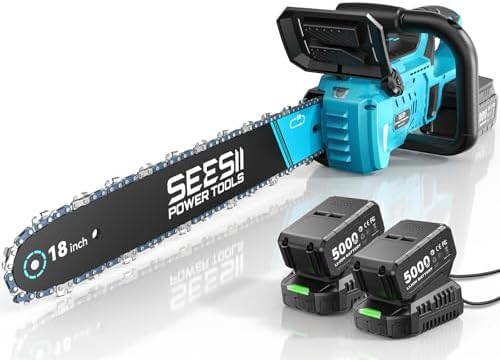
The cutting tool: SEESII 12-Inch Electric Chainsaw Cordless, Brushless Motor
 Visit on Amazon →
A 12-inch bar is a limb saw. That is not a knock, it is a job description. Twelve inches of bar handles downed limbs, storm branches, small trunks, and firewood rounds up to about the diameter of your forearm, and it does it without the weight of a 20-inch gas saw hanging off your hands all afternoon. If you have ever carried a big saw through a tangle of wet brush for two hours, you know why that matters.
The brushless motor is the part I care about most. No brushes means fewer wearing parts and less wasted energy per cut, which shows up as more cutting per charge and a motor that is not shedding heat into your hand. Cordless also means no fuel to mix, no carburetor to rebuild every other season, and no pull cord. My first saw was a cheap big-box special that vibrated my hands numb and needed carb work every other year. That is the gear that taught me to read fine print.
What you give up: bar length and the appetite to match. This is not the saw for a 20-inch trunk, and it is not the saw for felling a leaning tree over a fence. Those are rope and rigging jobs, or a gas saw with a longer bar and someone who knows how to use it.
What to check when it lands: chain tension out of the box, bar oil in the reservoir, and whether the chain was sharpened properly at the factory. Chains shipped dull are one of my standing complaints, and a dull chain on a good saw cuts worse than a sharp chain on a cheap one. The chain is the saw.
Flaws but not dealbreakers: A 12-inch bar has hard limits, and no amount of motor quality changes that. If your property has real timber on it, this is your limb saw, not your only saw.
This is the right pick for a homeowner cutting fallen limbs twice a year, clearing a fence line, or bucking storm wood into lengths the truck can take.
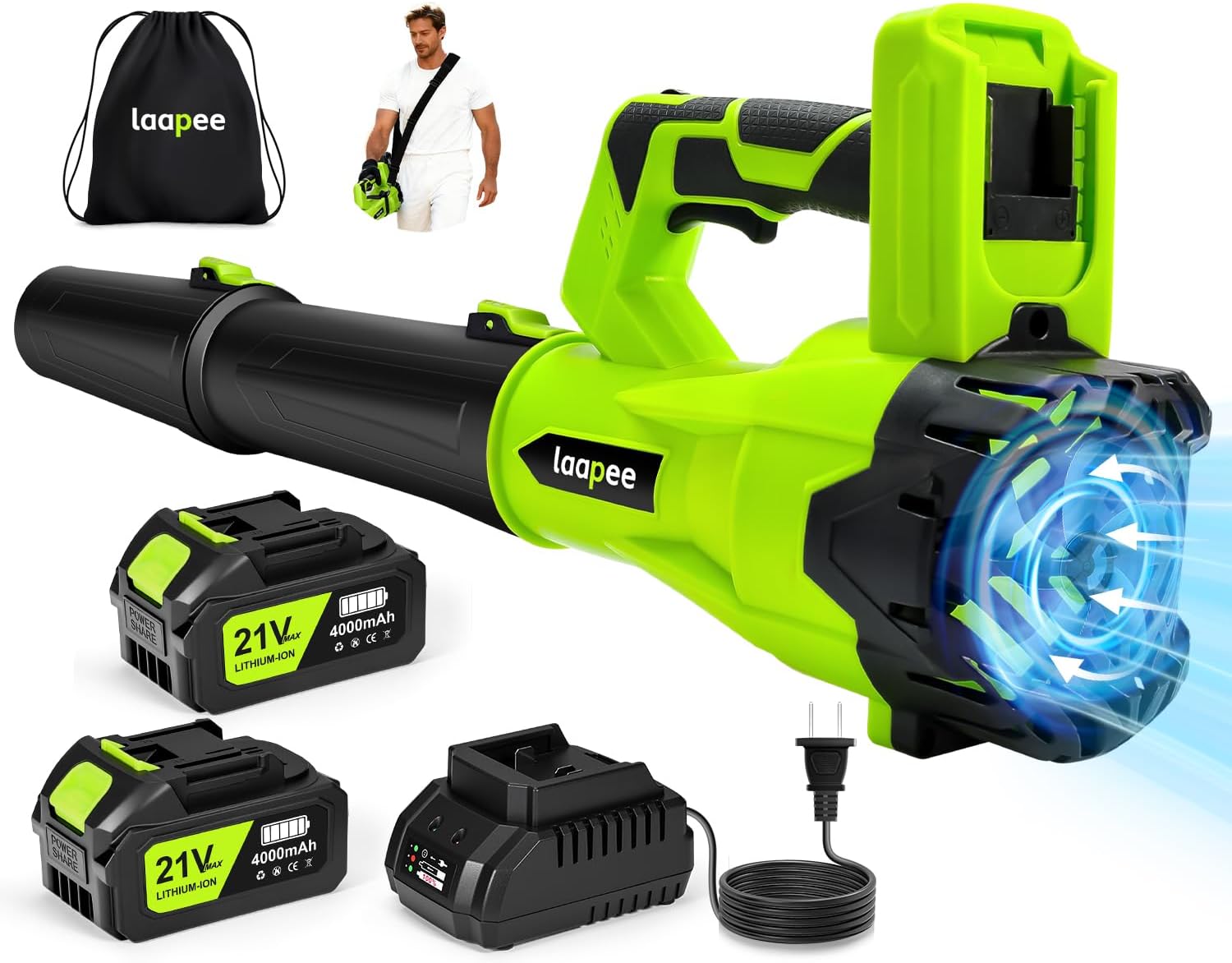
The cleanup tool: Leaf Blower Cordless 650CFM with 2x4.0Ah Battery Powered and Fast Charger
 Visit on Amazon →
CFM is the number that matters on a blower. Airflow moves leaves. Miles per hour is a sticker, and a blower rated in mph is selling you a number instead of a column of air. 650 CFM is a serious handheld number, the kind that moves wet leaves better than you expect from a battery tool.
The part of this kit that actually decides the job is the two 4.0Ah batteries and the fast charger. One battery runs the blower while the other charges, which turns a tool that dies halfway through a driveway into a tool that finishes the driveway. A single-battery blower with a wall wart charger is the trap here. You will wait all day to charge the second battery, and you will end up blowing the back half of the yard with a cord.
Two batteries also means two chances to find out whether the platform fits anything else you own. That is the question I ask before any cordless purchase. If these batteries only fit this blower, the blower is the cheap part and the batteries are the real price.
The wet-leaf test is the one I trust. Any blower moves dry oak leaves across a driveway. The good ones push wet leaves, wet wood chips, and the stringy pollen strands that carpet a drive every spring. A 650 CFM handheld will do that work, but full blast is where the runtime goes, so plan the job around the batteries rather than around the spec sheet.
Flaws but not dealbreakers: A handheld blower is not a backpack. If you are clearing an acre of wet oak leaves after a storm, you will want the harness and the all-day power of a gas backpack. This one is for driveways, walkways, decks, gutters at reachable height, and the fines left behind after you cut.
One more caveat: cold kills lithium runtime. Batteries that live in a freezing truck bed will not give you the same run time as batteries kept in a heated cab. Bring them in.
The order of operations
This is the part that saves you an hour. Follow it in order.
Step one: walk the pile before you touch a tool. Look up first. Hangers, cracked limbs still attached overhead, and spring poles under tension are what hurt people, not the wood on the ground. If anything overhead is cracked or hung up, that is a call to someone with a bucket or a rope, not a battery saw. Then look down and find your cut lines.
Step two: gear up. Chaps, eye and ear protection, gloves, and boots with grip. Kickback is the saw's way of telling you to respect it, and the bar comes up toward your face when the nose bites. Every pro wears chaps. The ten seconds it takes to put them on is not a debate.
Step three: cut the pile down to size, top down. Work the pile from the top, not from underneath. Cutting from underneath means the wood pinches the bar, and a pinched bar is how you burn out a motor or throw a chain. Buck limbs into lengths you can carry, and keep the bar tip out of the dirt. Dirt dulls a chain faster than any wood you will ever cut.
Step four: watch for bind. If a limb is resting on two supports, it is under tension on top and compression on the bottom. Cut the compression side first, then finish from the tension side. If the saw starts pinching before you finish the cut, stop, pull out, and come at it from the other direction. A battery saw has less torque to fight a bind with, so read the wood instead of muscling through it.
Step five: haul the wood out of the work zone. Move the cut rounds and the big limbs by hand or wheelbarrow before you start blowing. Blowing around wood you are going to move anyway is wasted battery.
Step six: blow last, and blow with the wind. Start at the far corner and work the debris toward your pile, not away from it. Blow downhill where you can, because gravity is free and battery is not. Wet chips and heavy debris need the nozzle closer to the ground and a slower sweep. Dry leaves need distance and speed.
Step seven: sweep the hard surfaces first. Driveway, walkway, deck, then the lawn edge. Hard surfaces give you a clean line to push debris along. Grass grabs leaves and holds them, so it takes a second pass and a lower angle.
Step eight: manage the batteries like they cost what they cost. Charge both before the job, swap at half power rather than at dead, and do not leave them on the charger for weeks. If you are running the saw and the blower off the same platform, plan which tool gets the fresh battery. The saw is the tool that stops the job when it dies, so the saw gets the full one.
Where cordless stops and gas starts
I tell homeowners battery is ready for light work, and I mean it. But I keep three gas saws in the truck for a reason, and you should know where the line is before you find it mid-cut.
Cordless wins on cold starts, weight, noise, and maintenance. No fuel to mix, no carb to rebuild, no pull cord, and it starts in the rain. For limbs, small trunks, trimming, and cleanup, it is the better tool.
Gas wins on sustained power and runtime. Big wood, big bars, an acre of wet leaves, a full day of cutting: that is gas territory. A backpack gas blower will finish a job a handheld battery blower cannot even start, and a 60cc saw will drop a trunk a 12-inch battery saw should never touch.
The honest rule: if the job needs a rope, a ladder, or a bar longer than your forearm, hire it out or bring out the gas. Mission accomplished means everyone goes inside at the end of the day.
What this all costs
Check current Amazon price on both tools, because prices move and the number on the page is the only one that counts.
The bigger cost is the platform, not the tools. Replacement batteries cost a real fraction of a whole new tool, so the question that decides your budget is not "what does this blower cost" but "what else do these batteries run." A kit with two batteries and a fast charger is worth more than a bare tool with a wall wart charger, because the second battery is what lets you finish the job.
Then budget for the small stuff that makes the big stuff last: bar oil, a couple of spare chains or a filing kit, and the safety gear. A sharp chain on a modest saw beats a dull chain on an expensive one every single time, and the file costs less than the chain.
The short version
Walk the pile. Gear up. Cut top down, keep the tip out of the dirt, and read the bind before the saw does. Haul the wood, then blow the fines last with the wind at your back. Charge both batteries, keep them warm, and know that the moment the job needs a longer bar, you have moved past what a cordless kit should be asked to do.
That is the whole workflow. A 12-inch brushless saw and a 650 CFM blower with two batteries will handle almost everything a storm leaves in a yard. The rest is order of operations, and that part is free.