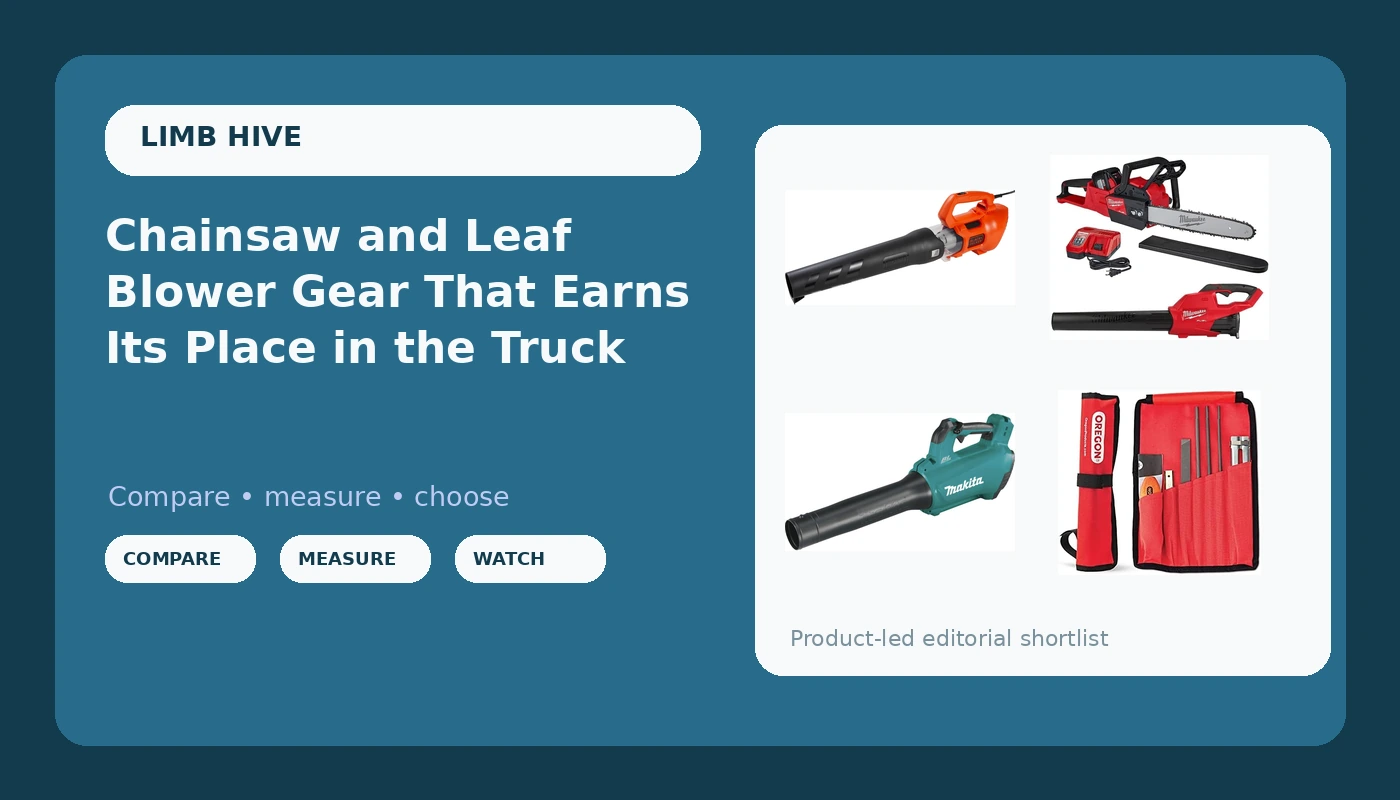
Storm season sorts gear faster than any spec sheet. I ran a tree crew for twelve years outside Charlotte, and the tools that survived were the ones that started cold, kept cutting when the wood was wet, and never needed a parts run mid-job. That is the lens I use on chainsaw and leaf blower gear now: not what the box promises, but what the tool has to do at 6 a.m. with a limb across a driveway. This piece is an explainer, not a ranking. Four specific products are on the table, and the job is figuring out which of them fits the work you actually have, and which of them you would regret buying.
Related: Battery Platform Lock-In: Why One Brand Beats Three →
Quick answer
If you want one purchase that covers both cutting and cleanup, the Milwaukee 2727-21HDP M18 Fuel 16 in. chainsaw is the anchor of this group, and it ships with a free blower kit, so the cleanup side comes along on the same battery platform. If you already own Makita 18V LXT batteries and a charger, the Makita XBU03Z is the blower that joins the gear you have instead of starting a new battery collection. If you would rather not deal with batteries at all, the BLACK + DECKER BEBL750 is a corded handheld rated up to 450 CFM and 140 MPH. And whichever saw you end up running, the Oregon 7-piece sharpening kit handles the thing that decides whether a saw cuts: the chain.
Four useful options
| Model | Best fit | What stands out |
|---|---|---|
| Milwaukee 2727-21HDP M18 Fuel 16 in. Chainsaw with Free Blower Kit | Cutting and cleanup from one purchase | 16 in. bar, M18 Fuel battery platform, bundled blower kit |
| Makita XBU03Z 18V LXT Brushless Cordless Blower, Tool Only | Households already on Makita LXT batteries | Brushless motor, 18V LXT platform, tool-only listing |
| BLACK + DECKER BEBL750 Corded Leaf Blower | Corded airflow with no battery clock | Rated up to 450 CFM and 140 MPH, axial design, lightweight build |
| Oregon Universal Chainsaw Field 7-Piece Sharpening Kit | Keeping any chain cutting | 7-piece kit, field format, universal application |
The full kit: Milwaukee 2727-21HDP M18 Fuel 16 in. Chainsaw with Free Blower Kit
The trade-off here is the one every battery saw carries: runtime is finite. A cordless saw cuts what you feed it, then it needs a charger and time, and a long storm day can outlast the batteries you brought. What you get back is a saw that starts without a pull cord, no fuel to mix, and no carburetor to rebuild after a season of sitting. The bundled blower is the other half of the value, because limb work always ends in a cleanup pass. If your work is a few fallen limbs and a driveway, that combination covers it. If it is a whole tree in a rainstorm, this is the saw you use until the gas saw comes out.
The platform pick: Makita XBU03Z 18V LXT Brushless Cordless Blower, Tool Only
Tool-only listings confuse people, and they are the best value on the page if you already run that platform. You are buying the bare blower and nothing else, which means no charger, no wall wart brick that only charges one battery at a time, and no extra battery to keep track of. If you do not already own LXT batteries, this stops being a bargain, because you would have to buy into the platform to use it at all. That is the whole question with cordless gear: the tool is the cheap part, the batteries are the investment, and the platform is the commitment.
The corded option: BLACK + DECKER BEBL750 Corded Leaf Blower
Corded is the underrated answer for a lot of yards. You give up the freedom to walk anywhere, and you take on an extension cord that has to reach every corner of the work. What you get back is airflow that does not fade as a battery drains and no recharge cycle in the middle of a job. For a driveway, a walkway, a pool deck, or the gutter line along the front of the house, a cord is a small tax. For half an acre of wet oak leaves, it is the wrong tool, and no corded handheld will change that.
The maintenance piece: Oregon Universal Chainsaw Field 7-Piece Sharpening Kit
This is the least exciting product here and the one that changes the most outcomes. A dull chain does not cut, it burns, and it makes any saw feel like a bad saw. I have watched a homeowner write off a perfectly good saw when the only real problem was a chain that had been through a season of dirty wood. A field kit means the file comes to the job, which matters because the moment you notice a chain is dull is the moment you are standing in the brush, not at the bench. Whatever saw you buy, budget for keeping the chain sharp.
Prices and availability may change. Product images, names, and retailer links are matched to verified listings. No current price, rating, stock status, or measured result is stated here without current evidence.
What the spec sheet actually tells you
Blower numbers are where most buyers get misled. Miles per hour is the speed of the air at the nozzle, and it sounds impressive because the number is large. Cubic feet per minute is the volume of air the blower moves, and volume is what pushes a pile of leaves down a driveway. A blower rated at 140 MPH and 450 CFM is giving you both numbers, and the CFM figure is the one to compare across models. Airspeed without airflow is a hair dryer. Airflow with modest speed moves debris.
The fan design matters too. Axial blowers pull air straight through the housing along the axis of the motor, which tends to produce a wide, high-volume stream, and that is the pattern you want for moving leaves across a hard surface.
On the saw side, bar length is the number everyone quotes and the one that matters least on its own. A 16-inch bar describes the length of the guide bar, not the size of the tree you can fell. What limits a saw is power and chain condition, and a bar longer than the power can pull just means a slower cut and more wear.
Voltage is the other misleading label. An 18V platform is not the same thing as 18 volts of usable cutting power, because the battery, the motor, and the electronics all decide what reaches the chain. The useful question is not the voltage on the label but which platform the battery belongs to and what else that battery fits. Finally, read the listing for the words "tool only." It means exactly that: no battery and no charger.
How to decide, in five steps
- Count the work you actually have. A driveway, a walkway, and a few fallen limbs are a different job from a property line of mature trees.
- Pick the battery platform first. If you already own batteries from a line, buy tools that fit them. If you do not, choose a platform with a wide range of tools so the batteries keep working after this purchase.
- Decide whether the job ends at the driveway or continues into wood. A blower alone is honest for cleanup, but if limbs need to come down to size, you need a saw in the plan.
- Read the listing for what is included. Batteries, chargers, and bundled blower kits change the real cost of a purchase more than the sticker on the tool does.
- Budget for maintenance. Chain sharpening, bar oil, fuel, and spare batteries are part of the cost of owning a saw.
Storm-season prep: what earns a spot in the truck
- Keep a sharp chain on the saw and a spare in the case. A chain change takes minutes, and a dull chain costs you the whole job.
- Carry the sharpening kit with the saw, not in the garage, because the moment a chain goes dull is never convenient.
- Match the battery count to the job length, not to the tool. Two batteries on a charger rotate better than one battery and a long wait.
- Decide ahead of time where the cordless gear stops and the gas gear starts, so you are not discovering the limit in the middle of a driveway.
- Confirm the paperwork before you rely on it. Warranty coverage lives on a card and a website, and it is worth knowing what is covered before the tool is in the truck.
Which option should you choose?
Choose the Milwaukee 2727-21HDP M18 Fuel 16 in. Chainsaw with Free Blower Kit when you want one purchase to cover cutting and cleanup and you are ready to commit to a battery platform. Choose the Makita XBU03Z 18V LXT Brushless Cordless Blower, Tool Only when you already own Makita 18V LXT batteries and just need the blower. Choose the BLACK + DECKER BEBL750 Corded Leaf Blower when your cleanup work sits close to an outlet and you would rather not manage batteries at all. Choose the Oregon Universal Chainsaw Field 7-Piece Sharpening Kit when you already have a saw and want it to keep cutting the way it did on day one.
Every listing here is a tool, not a guarantee. Battery runtime depends on the battery you own, the temperature, and how hard you run the trigger, and no product page can tell you what your specific yard will demand. Treat the specs as the starting point and the fine print as the deciding factor.
The bottom line
Two decisions matter more than any single spec on this page: which battery platform you commit to, and whether you keep your chain sharp. The Milwaukee saw with the bundled blower kit answers the platform question for cutting and cleanup at once. The Makita blower rewards you for a platform decision you already made. The corded BLACK + DECKER blower sidesteps batteries entirely for driveway and walkway work. And the Oregon sharpening kit protects the investment in all of them. Buy for the work you have, not the work you imagine, and read what is in the box before you decide.