Most storm seasons outside Charlotte do not announce themselves. You go to bed with a maple leaning over the driveway, and you wake up to a limb on the roof and a driveway carpeted in wet oak leaves. Every October a neighbor asks me the same question: what should be sitting in the garage before that morning comes?
Building a cordless storm cleanup kit is not about buying the biggest tool on the shelf. It is about buying one system that will still have juice in it at 6 a.m., and knowing which half of the job that system should never touch. I ran a tree crew for 12 years and I still take storm calls. My truck carries three gas saws for the big wood, and a battery kit handles everything else. That split works, but only when you set the kit up on purpose instead of grabbing whatever was on sale that week.
Here is the order I would do it in, and the two pieces I would start with.
Why you should trust me
I started as a ground guy at 19, hauling brush until my back quit on me, then learned to run a saw properly and never put one down. Twelve years running a crew, and storm season is still my busy season: hurricane debris pushed up from the coast, ice storms that bend maples over driveways, two trees on roofs this year alone.
My first chainsaw was a big-box special that vibrated my hands numb and needed a carburetor rebuild every other season. My first gas blower was worse. That gear taught me to read fine print, and the two things I check before anything else are the warranty card and what else the battery fits. I switched my light-duty kit to battery three years ago. I have been burned twice by proprietary packs and inflated runtime claims, so I time every battery with my phone, full blast, from a full charge, and I write the number in the job book.
That is the standard. If a tool cannot clear it, it does not get recommended, no matter how good the box looks.
How I picked and how I tested
Every saw and blower that comes through the shop gets the same five questions:
- Will it start cold, first try, after a night in the truck?
- How long does the battery actually last on full blast, timed with a stopwatch instead of read off the sticker?
- Does the battery fit anything else I own, or is this a dead-end platform?
- Can it cut wet wood or move wet leaves? Dry debris is easy. Wet debris is the truth.
- Would I hand it to my crew at 6 a.m. after a storm?
On the gear below, I have not run this exact set through a full storm season yet, so I am not going to pretend I have. What I can tell you is what the spec sheet actually promises, what the platform math looks like, and the specific things I would check in the first hour it sits in your garage. If a claim is not something I have verified myself, I say so.
Two numbers I trust, and you should too: the battery count and the charger count. A kit that ships with four batteries and three chargers is a kit you can actually run, because the wall wart that charges one pack at a time will have you standing around while the job waits. The other number is CFM on a blower, not miles per hour. Airflow moves leaves. Miles per hour is a sticker.
The two pieces I would start with
This is not a whole storm kit. It is the core of one, plus the small tool people forget until they need it at 9 p.m. in the rain.
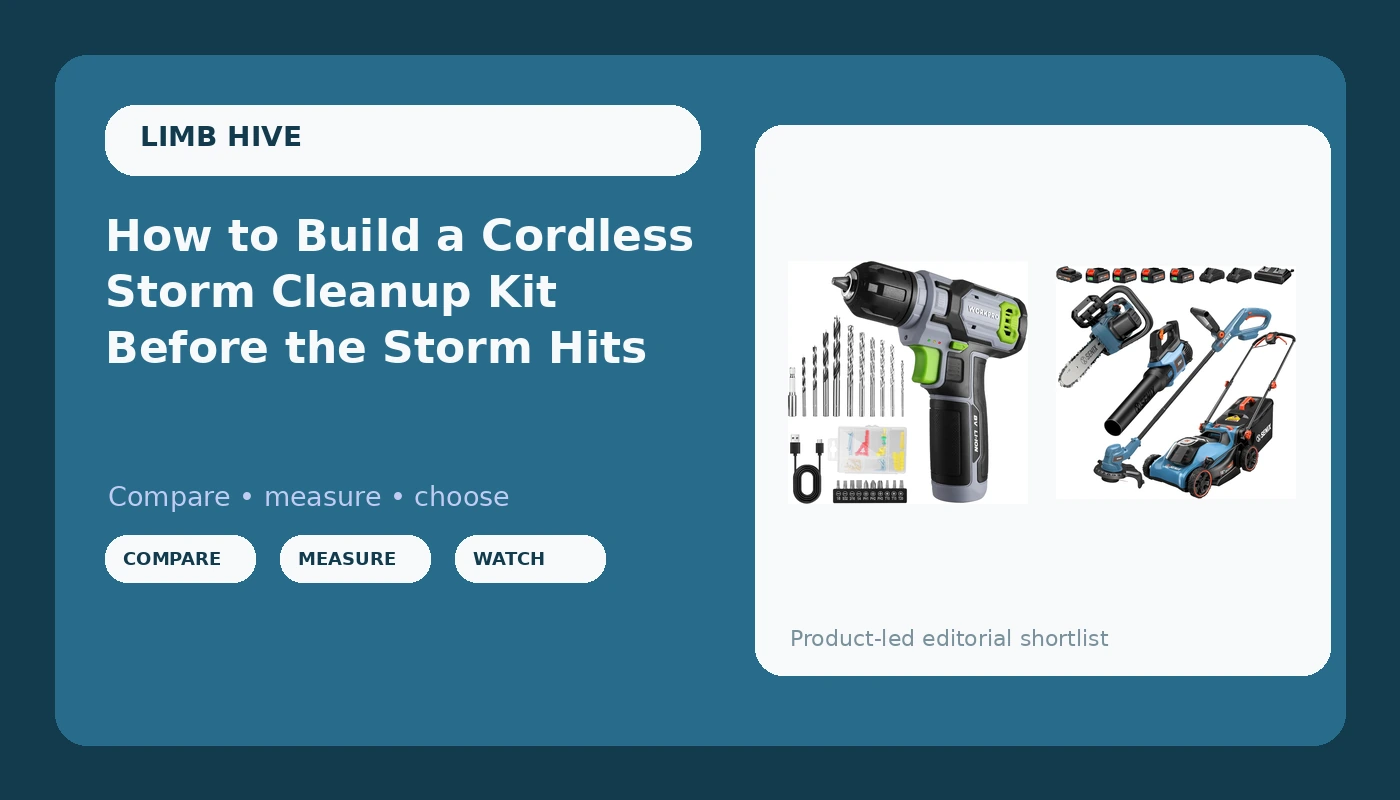
The platform pick: SENIX X2 40V 15-inch Cordless Lawn Mower | X2 20V String Trimmer, Leaf Blower, and Chainsaw [4-Piece Set], Includes 2.5Ah, (4) 4.0Ah Batteries, and (3) Chargers
![SENIX X2 40V 15-inch Cordless Lawn Mower | X2 20V String Trimmer, Leaf Blower, and Chainsaw [4-Piece Set], Includes 2.5Ah, (4) 4.0Ah Batteries, and (3) Chargers](/images/products/B0GY4J6PDB.jpg) Visit on Amazon →
Visit on Amazon →
Four tools on one purchase: a 40V mower with a 15-inch deck, plus a 20V string trimmer, a 20V leaf blower, and a 20V chainsaw. The battery math is the part that matters. It ships with a 2.5Ah pack, four 4.0Ah packs, and three chargers, which means you can keep two tools running and a third pack on the charger instead of standing in the driveway waiting on a single wall wart.
Here is how those four tools split up after a storm. The blower is the first thing off the truck, and it earns its keep on wet leaves, gutter grit, and the layer of pollen strands and oak tassels that a storm packs into a driveway. The trimmer clears around downed limbs before you put a bar anywhere near them, which is how you keep a chain out of dirt. The 20V chainsaw is a limb saw: think branches under about six inches, storm damage in a fence line, cleanup after the big cuts are already down. The mower is the last pass, once the debris is up and you are putting the lawn back together.
Two honest caveats. The 20V chainsaw in this set is not a storm saw. It is not the tool for a trunk on a roof, and it is not the tool for an afternoon of bucking big hardwood. If that is your job, this is the wrong purchase. And before you commit to any set, confirm which packs run the mower and which run the handhelds, because the whole value of a kit is that the batteries feed more than one tool.
Flaws but not dealbreakers: A 15-inch deck is a homeowner size. It is easy to push through a gate and around a downed limb, and it means more passes on a big lawn. Also, a 20V saw will pull a sharp chain through wet wood, but you have to keep the chain sharp. Dull plus wet is where small saws quit.
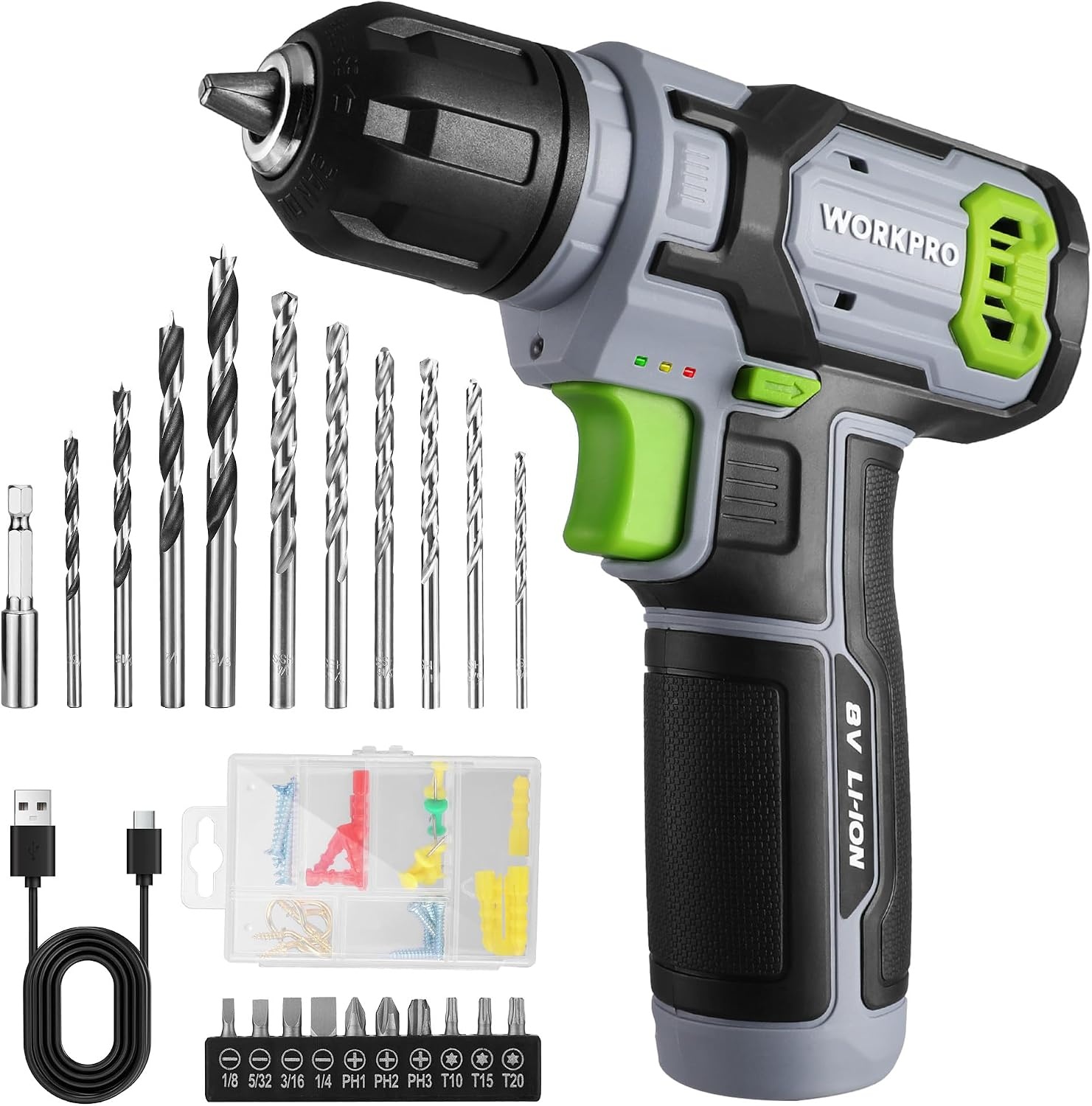
The small-jobs pick: WORKPRO 8V Cordless Drill Set with Battery and Charger, 3/8" Keyless Chuck
 Visit on Amazon →
This is the tool nobody puts on a storm list until the night they need it. A storm takes out a window, and suddenly you are cutting plywood and driving screws in the dark. It works the same way for tarp battens over a damaged roof section, a gutter bracket that pulled loose, a gate hinge the wind worked sideways, or a fence board you want braced before the next round comes through.
The spec sheet here is straightforward: 8V, a 3/8-inch keyless chuck, battery and charger in the set. The keyless chuck is what makes it useful, because it takes both round shank and hex shank bits, so you are not hunting for a special arbor at 9 p.m. Keep it loaded with a driver bit and a small box of exterior screws in the same tote as the batteries.
Flaws but not dealbreakers: 8V is light duty, and I mean that. It will drive fasteners and bore pilot holes all day, and it will stall on a long hole in dry hardwood. It is not a hammer drill and it is not an impact driver. Treat it as the kit's detail tool and it will do exactly what you bought it for. Also note the battery is proprietary to its own line, so this one is a standalone purchase, not a platform you are buying into.
The actual setup workflow
Now the part you came for. This is the order I would work in, and it works whether you bought a four-piece set or you are assembling the kit one tool at a time.
Step one: pick the platform before you pick the tool. Write down every battery tool you already own and what pack each one takes. Then decide whether the new kit feeds that pile or starts a second pile. One platform, or it is a paperweight. A kit with four batteries and three chargers is a real platform decision, not a throwaway.
Step two: size the tool to the job you actually do. A homeowner cutting fallen limbs twice a year does not need a pro saw. A 15-inch mower deck and a 20V limb saw cover the light half of storm cleanup. Be honest about your yard, your gate width, and how much wood you really cut.
Step three: time the runtime yourself, before the storm. Full charge, full blast, stopwatch on your phone. Time the blower with the trigger pinned. Time the saw making real cuts, not idling. Write both numbers in a notebook and stick it in the tote. The number on the box is marketing. Your number is the one you can plan around.
Step four: charge everything the night before a forecast. Every pack, every charger, one power strip, one outlet. Three chargers is the difference between a full rotation of batteries and a line of dead tools.
Step five: run the wet test on a calm day. Soak a pile of leaves and blow them. Cut a wet limb. You want to find the point where the tool quits in your own driveway, not on a stranger's roof at dawn.
Step six: stage the whole kit in one place. One tote: batteries, charger, chaps, eye and ear protection, gloves, bar oil, a file, a spare chain, the small drill, and a box of exterior screws. If the kit is scattered across the garage, you will spend the first 20 minutes of the worst morning of the year looking for it.
Step seven: do the paperwork. Check the warranty card is actually in the box, photograph the receipt and the serial numbers, and register the tools. If the card is missing and there is no email address on the site, that is worth knowing before you need service.
Step eight: work safe, and work in order. Clear the area before you cut. Take limbs from the outside in. Wear chaps and eye and ear protection. Watch for kickback, which is the saw's way of telling you to respect it, and never run a saw one-handed overhead or off a wet ladder rung. Battery tools are not an excuse to skip the gear.
Step nine: the after-storm routine. Dry everything, blow the vents and cooling slots clear, bring the batteries inside to room temperature, and store them at a partial charge rather than dead or full. Sharpen or swap the chain before it goes back in the tote. The chain is the saw. A sharp chain on a cheap saw beats a dull chain on an expensive one every single time.
What this kit is not
Gas still owns the big half of the job, and I am not going to pretend otherwise. A Stihl MS 261 is my pick for all-day work, light enough to carry and strong enough to pull a 20-inch bar. A Husqvarna 460 is the storm saw for big wood when the clock is running. A backpack gas blower finishes acreage that a handheld battery blower cannot even start.
None of that changes what a cordless kit is for. It is for the driveway, the pool deck, the walkway, the fence line, and the limbs you can reach from the ground. If your storm damage includes a trunk on a roof or a tree across a driveway that needs bucking into rounds, call someone with gas saws, and that includes me. And the 8V drill is a detail tool. It does not replace an impact driver or a hammer drill.
What this all costs
Check current Amazon price on both pieces, and look at the structure of the number rather than the number itself. A four-piece set with four batteries and three chargers is one purchase that replaces four separate ones, and that is where the money actually goes.
The recurring cost is the batteries. Replacement packs can run a large fraction of what a whole tool costs, so a proprietary platform is a commitment, not a bargain. That is why the first question is always what else the pack fits. If a battery feeds only one tool in your garage, you are paying that price again in three years, and probably again after that.
The free part is the discipline. Timing your own runtimes costs nothing. Sharpening a chain costs a file. Charging every pack the night before a forecast costs a power strip. Those three habits do more for your storm readiness than any single upgrade you can buy.
The math is the easy part. The evening you spend staging one tote, charging every pack, and timing the blower on full blast is what separates a kit that works at 6 a.m. from a pile of tools with dead batteries and a missing charger.
That is the job. Get the platform right, size the tools to the work, and let the battery carry the light half. Mission accomplished.