Most storm cleanup jobs go sideways on the order of operations, not on the tools. You reach for the saw first, drop the trunk, and then spend the rest of the afternoon dragging wet limbs across a yard you could have cleared with airflow. Cordless blower and gas chainsaw work is a two-tool job, and both tools get bought for the same day, which is exactly why they belong in the same decision.
I ran a tree service crew for twelve years outside Charlotte, starting as a ground guy at nineteen hauling brush until my back quit on me. Storm season is still my busy season: hurricane debris off the coast, ice storms that fold maples over driveways, and two trees off roofs this year alone. That work taught me the difference between a tool that starts at 6 a.m. in cold rain and one that only looks good on a spec sheet.
This is a how-to for the homeowner with a fallen oak in the side yard and a wet mat of leaves across the driveway. I will cover the order to run the two tools in, what each one has to do to earn a spot in the truck, and the checks that matter before you spend anything.
Why you should trust me
I have cut trees off two roofs this year, and I have watched more than one budget saw bog down on wet wood. My first chainsaw vibrated my hands numb and needed a carburetor rebuild every other season. My first gas blower was worse. That is the gear that taught me to read the fine print before the price tag.
Three years ago I moved my light-duty kit to battery and have not looked back, but I have also been burned twice by proprietary batteries and runtime claims that did not survive a stopwatch. Now every battery I buy gets timed on my phone, full blast, from a full charge, and every warranty card gets read before the tool gets used. My truck still carries three gas saws for storm calls and a battery trim kit for the easy stuff. Both halves of that kit exist for a reason, and this article is about which half you actually need first.
How I picked and how I tested
I judge storm tools on five questions, in this order.
- Will it start cold, first pull, after a night in the truck?
- How long does the battery really last at full blast, timed rather than claimed?
- Does the battery fit anything else I own?
- Will it cut wet wood or move wet leaves?
- Would I hand it to my crew at 6 a.m. after a storm?
The two tools below are the ones that answer the two halves of this job, and I will tell you where each one has to prove itself instead of repeating the box copy. Nothing here is a claim about runtime or airflow that I have not asked you to verify yourself with a stopwatch and a wet driveway.
Match the tool to the job
Wet debris is the truth teller. Any blower moves dry leaves on a breezy October afternoon. The ones worth owning move wet leaves off concrete, gravel, and a pool deck after three days of rain, and that comes down to airflow. CFM is the number that matters. Miles per hour is a sticker number that sells blowers to people who have never pushed a soaked mat of oak leaves.
Wood is the other half of the equation. A chainsaw has one job, which is to cut wood safely, and everything else about it is marketing. The chain is the saw. A sharp chain on a cheap saw beats a dull chain on an expensive one every single time, and wet wood chips are what separate a saw that works from a saw that stalls.
The two tools this job asks for
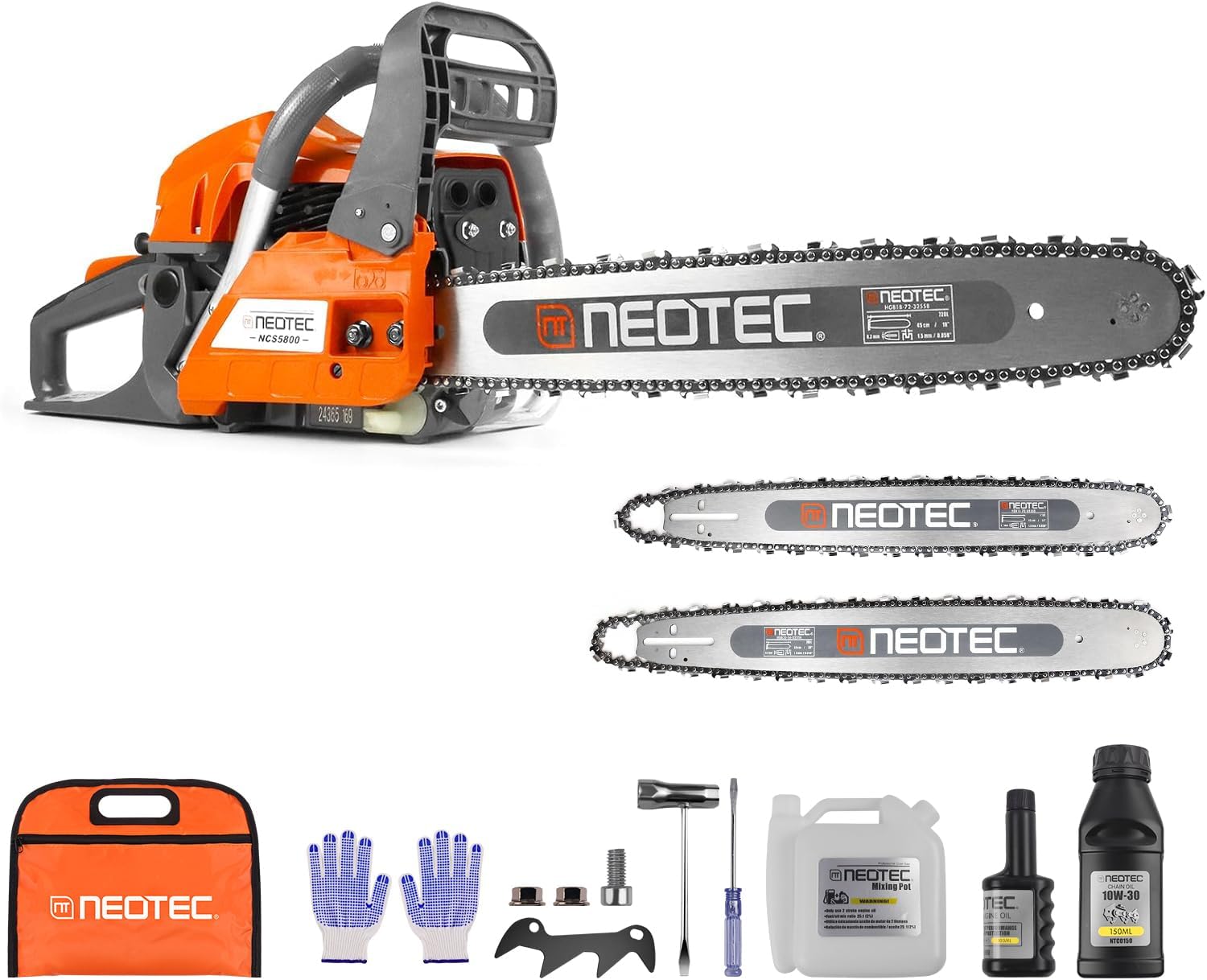
The storm saw: 58CC Gas Powered Chainsaw 18 20 Inch Bars Chain Ergonomic Chainsaw Chain Brake Anti-Vibration System, 2-Cycle Petrol Motosierra De Gasolina for Tree Cutting Firewood Wood Yard Cleaning
 Visit on Amazon →
The case for a gas saw on storm work is simple: no battery to run out, no charger to hunt for, and torque that stays with you through wet wood. This one is a 58cc two-cycle unit listed with 18 and 20 inch bars, and it carries the two features I check before anything else in this class. A chain brake on the top handle is not optional. An anti-vibration system is what keeps the handle from buzzing your hands numb by the third tank, and it is the difference between a saw you tolerate and a saw you can run all morning.
This is the tool for the homeowner who gets one or two big storms a year and wants the wood cut without waiting on a charge. It is also the tool for the guy who already owns a battery trim kit and does not want to spend pro-saw money for two weekends of work.
Two-cycle means you mix fuel, and mixed fuel goes stale. Buy ethanol-free if you can get it, mix what you will burn in a day or two, and dump the old mix rather than pouring it into the saw. A gas saw also demands cold-start discipline: choke on, a couple of pulls, choke off, one pull, and if it does not catch, stop pulling and think about fuel instead of blaming the brand.
Flaws but not dealbreakers: It is heavier than any battery saw and it makes noise you have to respect. Chaps, eye protection, and ear protection come out every single time. Check the chain before the first cut, because chains shipped on saws in this price range are often dull out of the box, and a dull chain is what makes people push, and pushing is how people get hurt.
Anyone with downed limbs, firewood duty, and a wet yard will get their money's worth here.
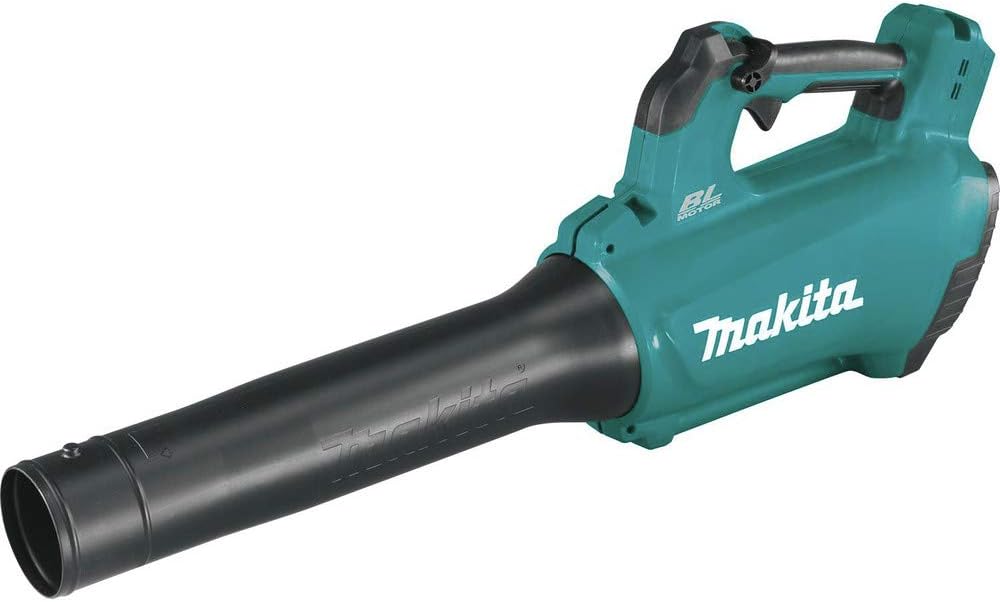
The cleanup tool: Makita XBU03Z 18V LXT® Lithium-Ion Brushless Cordless Blower, Tool Only
 Visit on Amazon →
The blower is the other half of the job, and the Makita XBU03Z is the one I point people at when they ask what to add to a kit they already own. It is an 18V LXT brushless cordless blower sold as Tool Only, and that detail decides whether it is a bargain or a trap. If you already run LXT batteries and a charger, this is the cheapest way to add real airflow to your garage. If you do not, price the battery and the charger before you decide, because a bare tool with no battery is a paperweight.
Airflow is the number that matters. A cordless blower in this class handles a driveway, a walkway, a pool deck, and the leaf litter around a foundation. Ask it to clear an acre of wet leaves and you will spend the morning swapping packs and checking your watch.
Full-blast runtime is the catch on every battery blower, and the honest way to judge one is a stopwatch, not the box. Time it from a full charge on high, then time it again on low, because low speed is what you use for pollen strands on a driveway and for blowing around parked cars without sandblasting the paint.
Flaws but not dealbreakers: Tool Only means no battery and no charger, and the wall wart chargers that ship with some kits only charge one pack at a time, so a second battery can leave you waiting. Handheld airflow will also never match a backpack gas unit, so if your property is measured in acres, this is a supplement rather than a replacement.
Anyone who already owns Makita 18V batteries and wants a light, quiet tool for hard surfaces will get the most out of this one.
The actual workflow
Now the part you came for. This order works whether the tree is already down or you are cleaning up after the crew leaves.
Step one: Walk it before you cut it. Look up, not just down. Hangers, limbs still attached under tension, and anything near a service drop. If a limb is hung up in another tree, that is a decision about calling someone, not a blower job.
Step two: Gear up. Chaps, eye protection, ear protection, gloves, boots. Nobody inside two tree lengths of a running saw. No exceptions, including the neighbor who wants to watch.
Step three: Cut the big wood first. Daylight and hands are the two things that run out. Buck the trunk and the heavy limbs while you still have both, working from the outside in. Keep the bar out of the dirt, because dirt files a chain down faster than wood ever will.
Step four: Watch the nose. Kickback comes from the top corner of the bar meeting something solid. Keep the saw at full speed, let the chain do the work, and never reach across the cut.
Step five: Cut downhill and with the wind. Chips and leaves go where gravity and airflow send them. Cut from the high side of the driveway and half your cleanup ends up in a pile you can reach.
Step six: Blow before you rake. Airflow first, rake second, bag last. A blower pushes wet leaves off concrete and gravel that a rake only smears around. Clear the hard surfaces, the fence line, and the foundation, then rake what is left on the grass.
Step seven: Charge the night before, mix the morning of. Batteries go on the charger the night before a storm is forecast, not the morning of. Mixed fuel goes stale in weeks, so mix small and run the saw dry if it will sit.
Step eight: Touch up the chain. Ten strokes a tooth by feel keeps a saw cutting straight. A dull chain burns the bar, overheats the engine, and makes you push the saw, which is the exact moment things go wrong.
The rules I do not break
- One battery platform, or it does not come home. A tool with a dead-end battery is a paperweight with a handle.
- No runtime claim without a stopwatch. If it is not timed on full blast from a full charge, it is marketing.
- No blower without the wet-leaf test. Dry leaves are easy. Wet leaves are the truth.
- No saw without a cold-start morning. If it will not fire at 6 a.m. in cold rain, it is dead weight.
- Warranty card in the box, or that goes in the review. If the paperwork is missing, you find out the hard way.
What to buy first
If the tree is already down on your property, the saw comes first. Nothing else in the garage takes a trunk apart, and no amount of airflow moves a limb off a fence. Get the wood cut and stacked while you have daylight, then deal with the surface.
The blower is the second purchase, and it is the one you will use more often, because leaves do not wait for a storm. If you already run the LXT platform, the cordless blower is the easy add and the one that earns its shelf space every week instead of twice a year. If you are starting from nothing, buy the battery and charger once, then buy bare tools from that point forward. That is how a kit gets cheaper over time instead of more expensive.
The bottom line
Storm cleanup is a sequence: walk it, cut it, then blow it. Buy the saw for the wood and the blower for the surface, and judge both on wet debris rather than a sticker. The saw has to start cold and hold up through wet wood. The blower has to move soaked leaves off concrete and run long enough to finish the driveway.
Do it in that order and the job is flat, satisfied, done. No drama, no second trip to the store, no tree on the roof next time.