Most storm damage does not need a bucket truck. It needs a sharp chain, a cleared work zone, and a sequence you follow in order. The morning after a hard blow, the average yard looks the same: a maple limb across the drive, a layer of wet oak leaves on top of it, and no safe place to put your feet. The pair that clears it fastest is a cordless leaf blower and gas chainsaw. The blower moves wet debris off your work zone and off the concrete, and the saw handles everything the air cannot push. This is the order I run that job in, and the two tools I would hand a homeowner who wants it done without calling a crew.
Why you should trust me
I ran a tree service crew outside Charlotte for 12 years. I started at 19 as the ground guy hauling brush until my back quit on me, and then I learned to run a saw properly and never put one down. Storm season is my busy season: hurricane debris off the coast, ice storms that fold maples over driveways, and a tree on a roof twice this year.
My first chainsaw was a big-box special that vibrated my hands numb and wanted a carburetor rebuild every other season. My first gas blower was worse. That is the gear that taught me to read the fine print. I moved my light-duty kit to battery three years ago and have not looked back, but I have been burned by proprietary batteries and inflated run time claims twice, so now I time every battery with my phone and I check the warranty card before I check the price.
How I judge a tool before it goes in the truck
Five questions, in order.
- Will it start cold, first or second pull, after a night in the truck?
- How long does the battery really last on the top speed, timed with a stopwatch instead of read off the box?
- Does the battery fit anything else I own?
- Can it cut wet wood or move wet leaves?
- Would I hand it to my crew at 6 a.m. after a storm?
A tool that fails any of those sits in the garage while I reach for something else. The two picks below answer those questions for the kind of job most homeowners actually have: one downed limb, a driveway full of debris, and a Saturday morning to deal with it.
The two tools this job needs
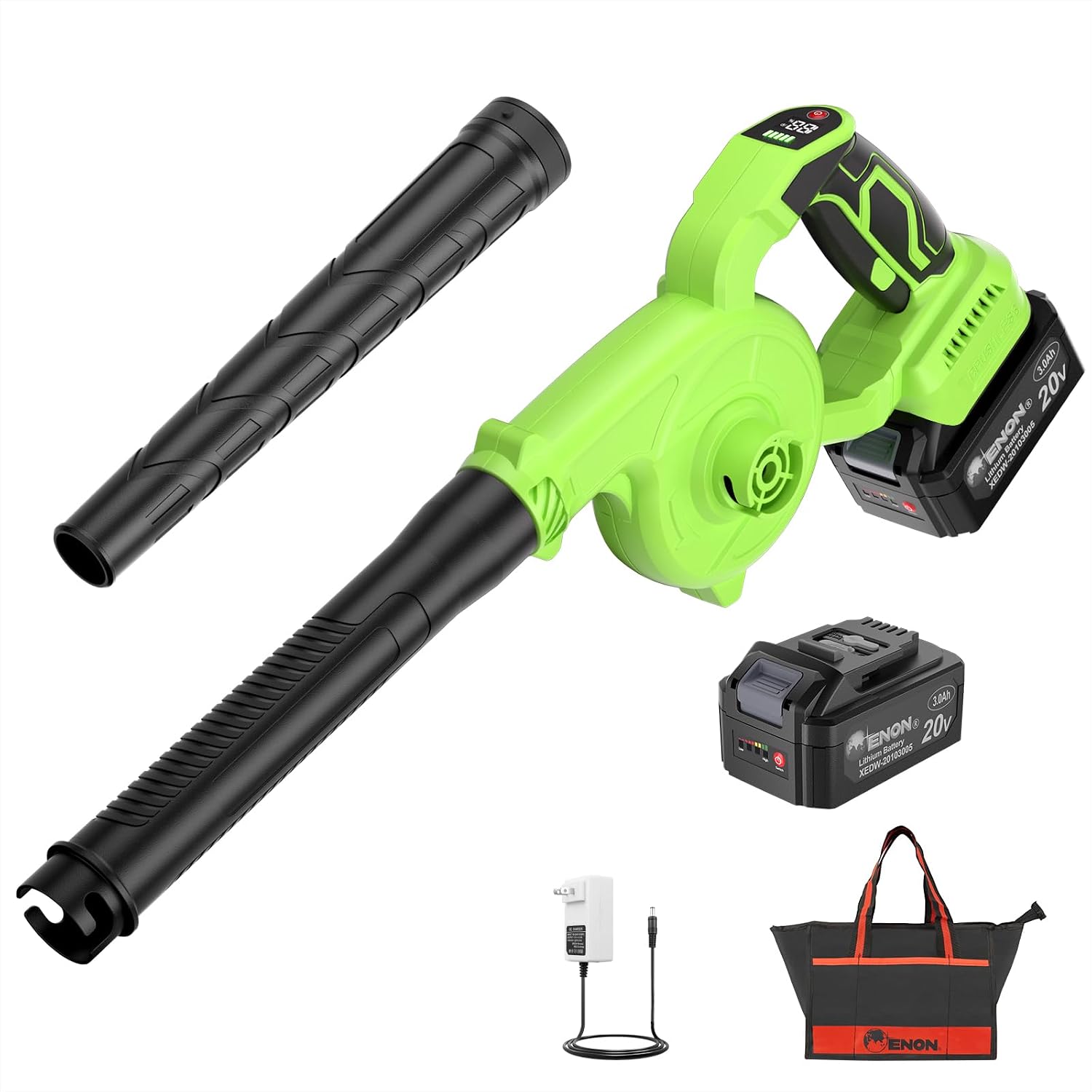
Cordless blower: Leaf Blower- Brushless Electric Cordless Leaf Blower with Battery and Charger, 3 Speed Mode, Lightweight Cordless Blower for Blowing Leaves, Patio Cleaning, Blowers for Lawn Care and Dust
 Visit on Amazon →
This is the light half of the kit, and on a storm cleanup it is the tool you pick up first. It comes with the battery and the charger in the box, which matters more than any number on the listing, because a blower with a dead-end battery platform turns into a paperweight the day the cell quits. The brushless motor has fewer wearing parts and draws less current per minute of run time than the old brushed designs, so the charge goes further.
Three speeds are the part that actually gets used. Low handles pollen strands and dust on a walkway. The middle setting moves dry leaves off a lawn without blasting them into the neighbor's yard. The top setting is the one that matters after a storm, when the leaves are wet and stuck to the concrete.
The honest catch with any cordless blower is run time at the top speed. The number on the box is not the number you get. Time it yourself on the first full charge, full blast, with your phone, and write the real number on the battery with a paint pen. Then look at the charger: a single-battery wall wart means the second battery waits all afternoon. If that battery also fits your trimmer or your drill, this is an easy call. If it fits nothing else you own, price a spare battery into the decision before you buy. Check current Amazon price.
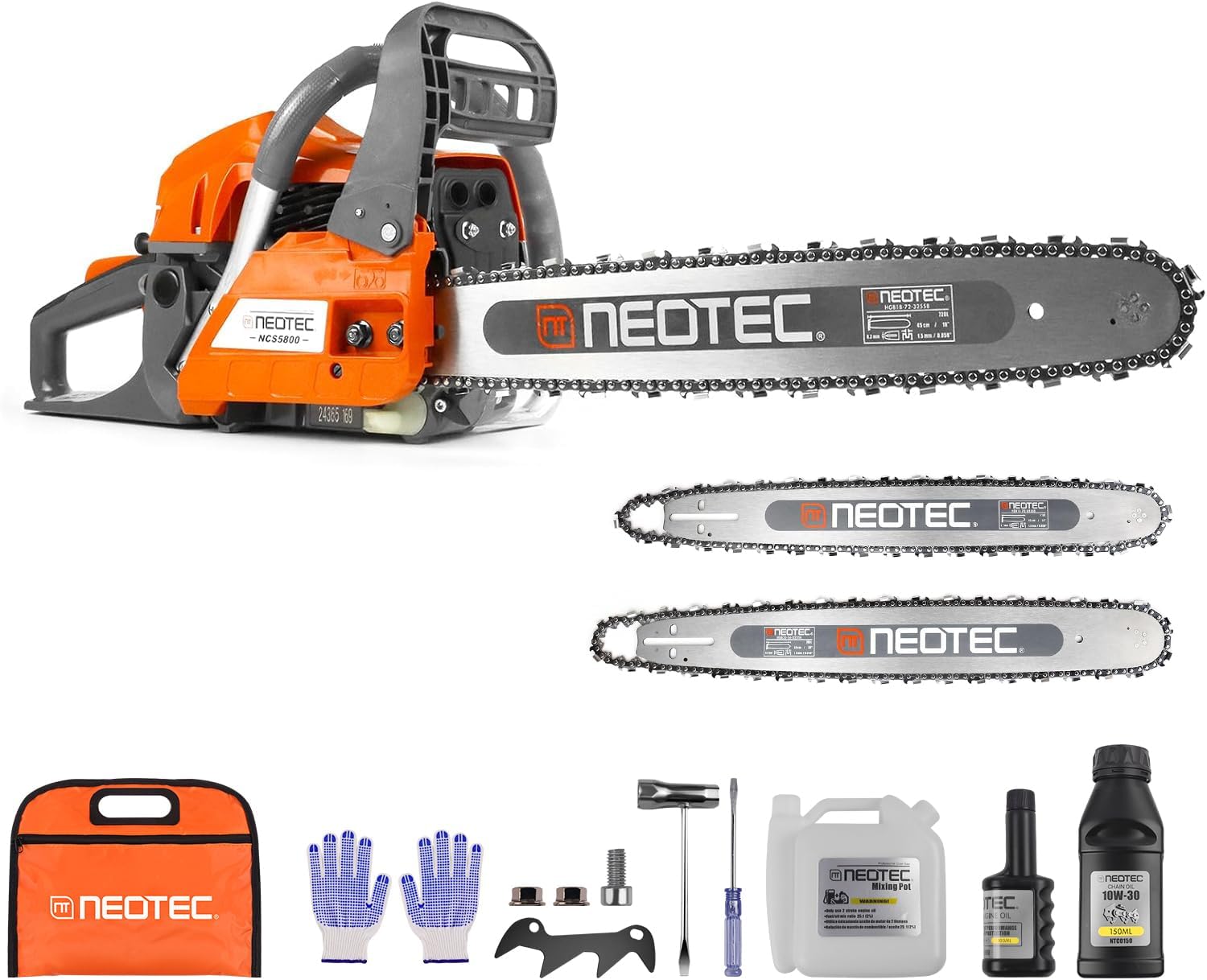
Gas saw for the big wood: 58CC Gas Powered Chainsaw 18 20 Inch Bars Chain Ergonomic Chainsaw Chain Brake Anti-Vibration System, 2-Cycle Petrol Motosierra De Gasolina for Tree Cutting Firewood Wood Yard Cleaning
 Visit on Amazon →
Fifty-eight cc is storm and firewood territory. This is the tool that takes the trunk of a downed maple and turns it into rounds you can actually lift, and it is offered with 18-inch and 20-inch bars so you can match the bar to the wood in front of you rather than the other way around.
Two features on this saw earn their place. The chain brake is the safety system that stops the chain when the bar kicks back, and you test it before every session: run the saw up to speed, roll your left wrist against the guard, and the chain should stop dead. If it does not, you do not cut today. The anti-vibration system matters on a long morning, because a saw that numbs your hands is a saw you set down early, and the last cut of a tired session is the one that bites.
Two-cycle gas also means you own the fuel problem. Mix fresh, run ethanol-free gas if you can get it, and never leave old mix sitting in the tank over the winter. A saw that will not start at 6 a.m. in cold rain is usually a fuel problem, not a brand problem. Buy the bar length to match the job: a 20-inch bar on a 58cc powerhead is a reasonable pairing, and an 18-inch bar is lighter and easier to control if most of your wood runs under a foot. Check current Amazon price.
The job, step by step
Step one: walk the site before you touch a starter cord. Look up first. Hangers, leaners, split trunks still standing, anything resting on a roof or a fence, and any line that touches a limb. Pick two escape routes at 45 degrees off the trunk and know which one you are taking before the saw starts. If the tree is on a wire, stop and call the utility. That is not a job for a Saturday.
Step two: gear up and check the saw. Chaps, a helmet with a face screen, hearing protection, boots, gloves. Then the saw itself: chain brake test, chain tension, bar oil, fuel. Do all of that before the saw is running, not after it is.
Step three: blow the work zone first. This is the step most homeowners skip. Wet oak leaves hide a curb, a stump, a garden hose, a piece of rebar, and every one of those is a way to trip while holding a running saw. Run the blower on high over the ground where you will stand and where the limb will land. It also shows you the cut line, which is worth more than it sounds.
Step four: take the small stuff by hand. Anything under wrist size goes to loppers or a hand saw. Save the powerhead for wood that needs it, and keep the number of cuts happening near your feet to a minimum.
Step five: buck the downed wood. Work from the outside in and keep the bar out of the dirt, because dirt is what dulls a chain faster than anything else in this job. If a limb is bound under tension, cut the compression side first and stay out of the path of the wood when it releases. A sharp chain on a modest saw beats a dull chain on an expensive one, every single time.
Step six: clear as you go. Blow the chips and leaves off the concrete before they get walked into the house, and before the next rain mats them down into a layer that has to be scraped instead of blown. This is where the blower earns its money. Wet wood chips and wet leaves are the test that separates a real blower from a toy, and it is the only test I care about.
Step seven: shut down and maintain. Dump or stabilize the fuel, clean the air filter, touch up the chain with a file (ten strokes per tooth), and put the battery on the charger. Take it off when it is full, and do not store it in a cold shed all winter.
The two tests that decide whether a tool stays
Cold start is the first one. A saw that needs twenty pulls in the rain is not a saw, it is an arm workout. Fresh mix, correct choke procedure, and a clean air filter solve most of it, but a tool that fights you at 6 a.m. every time will eventually lose its spot in the truck.
Wet debris is the second. Any blower moves dry leaves, so dry leaves prove nothing. Wet leaves on a driveway, wet chips on a stump, and a mat of debris stuck to concrete are the real evaluation. Judge the blower on that and judge the saw on wet wood, which is harder to cut, dulls a chain faster, and shows you whether the powerhead actually has torque or just rpm.
What these two tools will not do
A handheld cordless blower will not clear an acre of wet oak leaves on one charge. That is backpack gas territory, and no amount of marketing changes the physics. A 58cc saw is also not a climbing saw, and it is not the tool for pruning over your head. Neither tool belongs on a roof, and no saw should be run on a roof by one person with a rope, no matter how the videos look.
If the tree is on the house, leaning on a wire, or bigger than you are comfortable with, call a pro. That is not a knock on these tools. It is the job talking.
What the job costs
Check current Amazon price on both tools before you decide anything, because both listings move and the numbers matter less than the platform decision underneath them. The real math is this: two tools, one battery decision, and a Saturday morning. Weigh that against what you would pay someone else to clear a single downed limb, and against the repair bill for the thing you were trying to protect when the limb came down.
The cost per year drops every time a storm rolls through your neighborhood, and it drops fastest when you take care of the chain and the battery. Buy the saw you will actually maintain, buy the blower whose battery fits the rest of your garage, keep the chain sharp, and run the job in order. That is the whole thing.