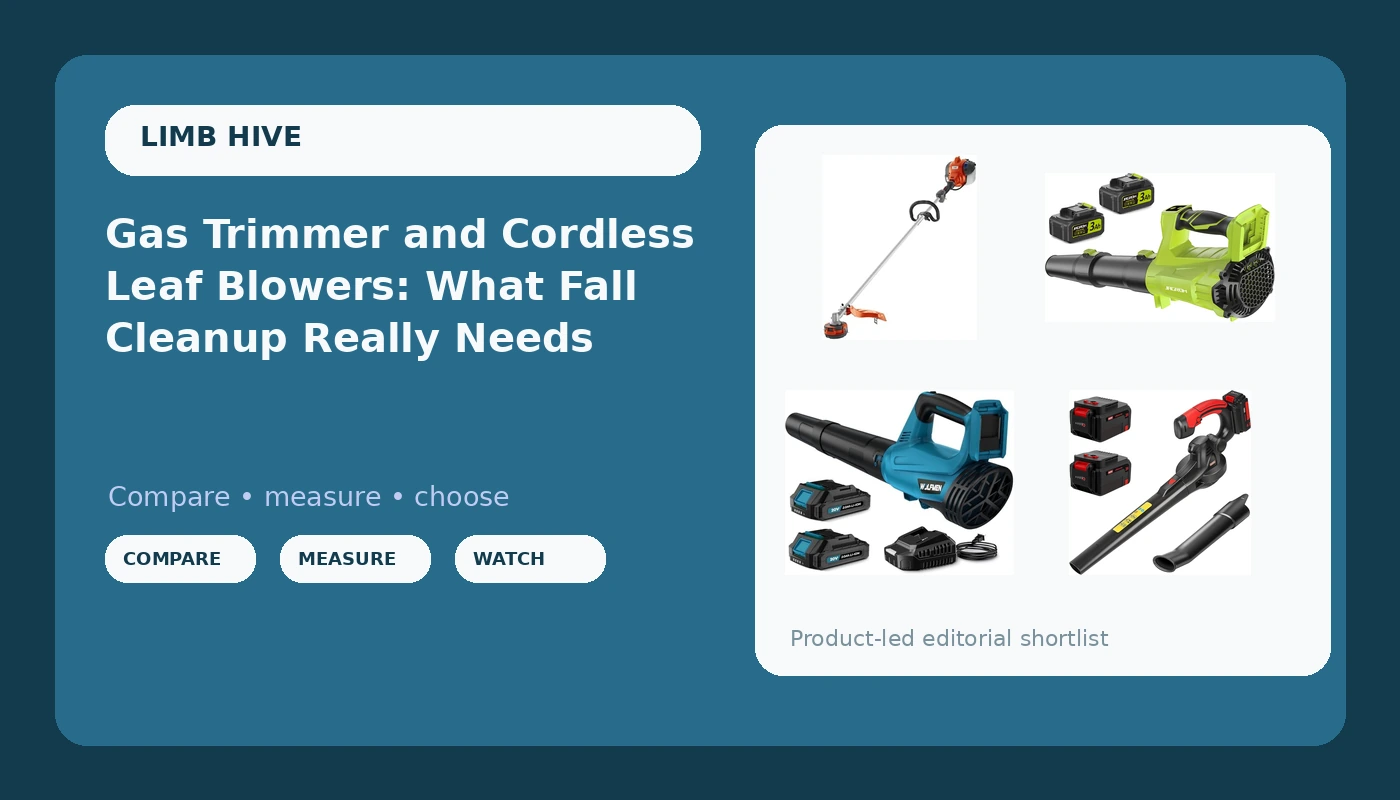
Fall cleanup around here runs on two very different jobs. The first is leaves: oak, maple, and sweetgum coming down for six straight weeks onto driveways, decks, and gutter lines. The second is growth: fence rows, ditch banks, and the strip along a foundation that keeps pushing until the first hard freeze. That is why a fall shopping list usually ends up holding a trimmer and a blower at the same time, and why cordless leaf blowers now sit in the same cart as gas tools instead of in a separate category. The listings blur together fast. A blower rated at 680 CFM and a blower that ships with two batteries are solving different problems, and a gas trimmer solves a third problem entirely. This is about matching the tool to the debris, then matching the battery to everything else you already own.
Related: Cordless Leaf Blower CFM Ratings Explained →
Quick answer
Start with what you are actually clearing, not with the tool type. Hard surfaces under a heavy leaf drop call for airflow, which is measured in cubic feet per minute, not in miles per hour. If the yard is big enough that one battery will not finish the session, a kit with two batteries included removes the mid-job charging stop. If the real problem is overgrown edges and thick grass rather than leaves, a gas trimmer with an 18-inch cutting path does work no handheld blower will do. Match the debris first, then the battery platform you already own, then the price.
Four useful options
| Model | Best fit | What stands out |
|---|---|---|
| Husqvarna 130L Gas String Trimmer, Trimmer Head, 18-Inch | Overgrown edges, fence lines, thick grass | Gas engine, 18-inch cutting path, no battery or charger to manage |
| Electric Leaf Blower Cordless with 3.0Ah Battery and Charger, 680CFM 230MPH | Heavy leaf drop on driveways and other hard surfaces | Rated 680 CFM and 230 MPH, ships with a 3.0Ah battery and charger |
| Leaf Blower, Electric Leaf Blower Cordless with 2 Batteries and Charger, 2 Speed Mode, Lightweight Cordless Leaf Blowers for Lawn Care, Blowing Leaves, Patio Cleaning and Dust, Green | Whole-yard sessions where runtime is the limiting factor | Two batteries and a charger included, two speed modes |
| MZK 20V Cordless Leaf Blower, Lightweight Electric Blower | Quick tidy-ups on patios, walkways, and garage floors | 20V cordless platform in a lightweight electric blower |
The gas option: Husqvarna 130L Gas String Trimmer, Trimmer Head, 18-Inch
The trade-off with gas is everything that comes with gas. You buy mixed fuel, you pull to start, and you deal with a carburetor if the trimmer sits for months with old fuel in it. What you get in return is a tool that keeps running as long as you keep filling it, which matters on a long fence line where a battery blower would already be on its second pack. If your trimming is fifteen minutes of touch-up work twice a month, this is more tool than the job needs. If it is a quarter mile of ditch bank, it is the right kind of tool.
The high-airflow cordless: Electric Leaf Blower Cordless with 3.0Ah Battery and Charger, 680CFM 230MPH
Here is the honest catch with any high-output cordless blower: airflow and runtime pull against each other. The 680 CFM number is a peak rating, and running at peak drains a battery faster than any other mode the tool has. One 3.0Ah pack is a reasonable match for a driveway, a walkway, and a patio in a single session. It is not a match for an acre of wet oak leaves, and no handheld battery blower is. Check what else the battery fits in that brand's line before you buy, because a battery that only powers one tool is a battery you will replace at half the price of a new blower.
The two-battery kit: Leaf Blower, Electric Leaf Blower Cordless with 2 Batteries and Charger, 2 Speed Mode, Lightweight Cordless Leaf Blowers for Lawn Care, Blowing Leaves, Patio Cleaning and Dust, Green
Two batteries only solves the runtime problem if you understand what the charger does. If it is a single-bay brick that charges one pack at a time, you are not running two batteries in parallel, you are rotating them: one in the tool, one waiting. That still beats standing in the driveway watching a charger, but it is not unlimited runtime, and no listing should be read as if it were. The low speed mode is worth more than it sounds. Full blast is for wet debris and matted leaves. Half power is for dry leaves on a deck, pollen strands on a walkway, and anything you would rather not blast into the neighbor's yard.
The light-duty pick: MZK 20V Cordless Leaf Blower, Lightweight Electric Blower
A 20V blower is not going to clear a yard full of wet oak leaves, and it is not marketed as one. What it does is handle the jobs that otherwise get a broom: the garage floor, the front walk, the deck after a windy afternoon, the car before you pull it out of the driveway. If you already own 20V tools from the same line, the bare-tool math is simple, because you are buying a shell and using batteries you already have. If you do not, price the kit against the two-battery option above, since a bigger blower for a slightly higher cost is a better deal than a small blower plus a battery platform you will not expand.
Prices and availability may change. Product images, names, and retailer links are matched to verified listings. No current price, rating, stock status, or measured result is stated here without current evidence.
CFM, mph, and the number that actually moves leaves
Miles per hour is a speed reading at the nozzle. Cubic feet per minute is a volume reading. A leaf does not care how fast the air is leaving the tube, it cares how much air arrives to lift it off the concrete. That is why a blower rated in mph first is usually selling a sticker rather than airflow. A narrow nozzle can push the mph number up while moving less air overall, and a wide, high-volume stream is what actually rolls a wet leaf pile down a driveway.
Wet debris is the honest test. Dry leaves will move with almost anything, including a broom. Wet leaves, matted grass clippings, and wet wood chips are heavier, they stick to pavement, and they need both volume and pressure to break loose. If a listing gives you a CFM figure, treat that as the number to compare. If it gives you only mph, you are being told half the story.
Runtime is the other half. Every cordless blower in this group runs at its highest output for a shorter time than at low speed, and that gap is wider than most people expect. The listing may quote a runtime, but a quoted number is a claim until you run the tool yourself. Plan on the assumption that full blast is a limited resource and the low speed mode is what carries most of the job.
Battery platforms, chargers, and what two batteries really mean
The most expensive mistake in cordless tools is buying into a battery that fits nothing else you own. A replacement pack can run close to half the cost of an entirely new tool, so a dead-end platform is not a purchase, it is a subscription. Before you buy any cordless blower, look at what else the brand sells on that same battery, and whether bare tools are available without a charger.
Chargers deserve the same scrutiny. A wall wart style brick that only charges one battery at a time changes how you work: you are always waiting on the second pack. A kit with two batteries and one single-bay charger means rotation, not endless runtime. A kit with two batteries and a two-bay charger means you can actually work through a long afternoon. Check the charger count as carefully as the battery count.
Then check what is in the box. Charger, battery, and for the trimmer, the trimmer head. A tool that arrives without the piece you assumed was included is not a bargain, it is an errand. And read the warranty card while you are at it, because a warranty that is not documented in the box is a warranty you will argue about later.
- Measure the job first. Count the square footage of hard surface you blow, and the linear feet of edge you trim, before comparing tools.
- Decide whether one battery finishes the session. If it does not, a two-battery kit beats buying a spare pack later.
- Check the battery platform against the tools you already own. If it fits nothing else, price that in.
- Confirm what ships in the box: batteries, charger, bay count, and the trimmer head on the gas unit.
- Read the warranty terms and the return window before the first tank of fuel or the first full charge.
Practical guidance for fall cleanup
- Blow when the leaves are dry if the schedule allows, since dry debris moves with far less airflow and less battery.
- Work with the wind, not against it, and start at the far end of the driveway so you are pushing debris toward your pile instead of back over clean ground.
- Never blow leaves into a storm drain or a creek. Bag them, tarp them, or pile them where the town picks up.
- Keep batteries indoors, out of the cold, and off the charger once they are full. Cold packs lose capacity fast on a November morning.
- Wear eye protection when you blow, and long pants when you run the trimmer. A trimmer throws grit and cut line with no warning.
Which option should you choose?
Choose the Husqvarna 130L Gas String Trimmer, Trimmer Head, 18-Inch when the real work is overgrown edges, fence lines, and thick grass rather than leaves, and when you do not want another battery platform in your life. Choose the Electric Leaf Blower Cordless with 3.0Ah Battery and Charger, 680CFM 230MPH when the job is a heavy leaf drop on driveways, walkways, and other hard surfaces, and airflow is the limiting factor. Choose the Leaf Blower, Electric Leaf Blower Cordless with 2 Batteries and Charger, 2 Speed Mode, Lightweight Cordless Leaf Blowers for Lawn Care, Blowing Leaves, Patio Cleaning and Dust, Green when the yard is large enough that one battery will not finish the session and you want a spare pack in the rotation from day one. Choose the MZK 20V Cordless Leaf Blower, Lightweight Electric Blower when the work is small, frequent, and close to the house, and you already own batteries on that platform.
Two caveats. First, nothing here is a measured runtime or a durability verdict on these specific units. The CFM, MPH, battery capacity, and speed modes come from the listings themselves, and the rest is how these categories of tool behave in practice. Second, a spec sheet cannot tell you whether a battery fits your existing tools. That is a question for the product page and the manufacturer's platform list, and it is the one thing worth checking twice.
The bottom line
The trimmer and the blower are not competing purchases, they are answers to different debris. If your fall problem is leaves on pavement, buy airflow and buy it in a platform that has more tools behind it. If your problem is growth along a fence line, buy the gas trimmer with the 18-inch path and stop worrying about runtimes. If you want one cordless blower to cover both the driveway and the deck, pick the kit whose battery count matches the size of your yard, then confirm what else that battery fits before you check out. Mission accomplished is a driveway you can see and a fence line you can walk past.