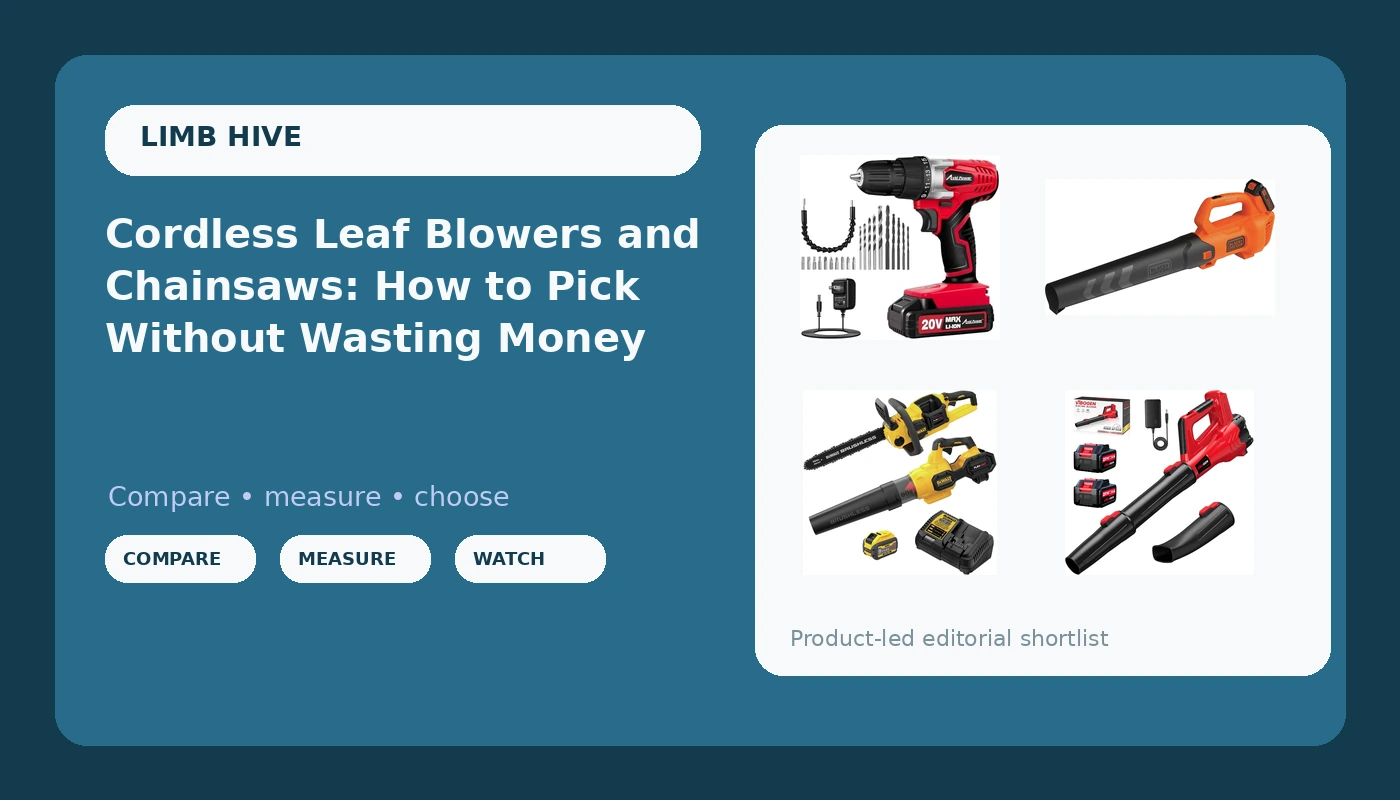
A cordless leaf blower and chainsaw purchase looks simple until you are standing at the returns counter. The sticker talks about miles per hour, the box promises runtime, and nothing on the shelf tells you whether the battery will fit anything else you already own. That last question is the one that decides whether a tool earns a spot in the garage or becomes a paperweight with a charger attached. The four options below cover the full range of what most homeowners actually need: a high-voltage combo kit for storm debris, a mid-priced 20 volt blower for driveways and walkways, a budget cordless blower for small yards, and the indoor tool people forget to budget for. Here is how to read the numbers so the second purchase costs less than the first.
Related: Gas vs Battery Leaf Blowers: Which One Belongs in Your Garage →
Quick answer
Match the tool to the debris, not to the spec sheet. For a driveway, a walkway, a pool deck, and a couple of flower beds, a 20 volt cordless blower with the battery and charger in the box handles the job, and a cordless chainsaw only makes sense once you already own a battery platform you plan to keep. If your property has real storm exposure, meaning wet limbs, big oaks, and a long drive, the higher voltage brushless combo kit is the version that will not stall on the first wet load. Buy the platform first and the tool second. No single option here is the quietest, fastest, or safest; each one fits a different size of job.
Four useful options
| Model | Best fit | What stands out |
|---|---|---|
| DEWALT FLEXVOLT 60V MAX Blower & Chainsaw Combo Kit, Brushless, 3-Ah Battery | Storm cleanup and larger properties | Brushless blower and brushless chainsaw together on the 60V MAX FLEXVOLT platform |
| BLACK+DECKER 20V MAX Cordless Leaf Blower with Battery and Charger (BCBL700D1) | Driveways, walkways, pool decks | Two-speed axial design rated up to 90 MPH and 320 CFM, battery and charger included |
| Electric Leaf Blower Cordless with Battery and Charger for Lawn Care Small | Small yards and a first blower | Lowest entry point in this group, battery and charger included |
| AVID POWER 20V Cordless Drill Set for Home DIY & Beginner Projects | Furniture assembly and indoor work | Variable speed, 3/8 inch keyless chuck, 22 bits, battery and charger included |
Storm-ready kit: DEWALT FLEXVOLT 60V MAX Blower & Chainsaw Combo Kit
This is the option for the property where a storm drops a limb across the drive and the blower has to move wet debris off pavement, not just dry leaves off grass. The honest trade-off is weight and money: higher voltage packs are heavier in the hand and cost more up front than a 20 volt handheld. The other thing to plan for is charge order. With one battery running two tools, you will either work the blower first and cut second, or you will want a second pack on the bench. Before you buy, check whether that pack fits the other tools you already own, because a battery that only serves one kit is the most expensive kind.
Everyday blower: BLACK+DECKER 20V MAX Cordless Leaf Blower
The 320 CFM number is the one to pay attention to, and it is the reason this blower is a fair match for pavement and mulch beds rather than an acre of wet oak leaves. The low speed setting is not a gimmick either. It is what you use on pollen strands and loose mulch so you are not blowing the bed into the street. The catch with any handheld battery blower is runtime on the high setting, so plan on clearing the hard surfaces first and the grass last. If you already own other tools on this 20V MAX platform, the included pack is worth more than the blower itself.
Budget starter: Electric Leaf Blower Cordless with Battery and Charger for Lawn Care Small
Be honest with yourself about the size of the job before you buy at this end of the market. This blower is built for a small property, and it will do a sidewalk, a set of steps, and a patio without complaint. It is not the tool you hand to someone clearing a quarter acre of wet leaves after a November rain. The other thing to weigh is the replacement battery. On any budget cordless tool, a second pack can approach the cost of the tool, so check what the pack fits before you commit to the platform. If the answer is "nothing else," treat the whole purchase as a one-job expense and price it that way.
Shop-side pick: AVID POWER 20V Cordless Drill Set
Here is the practical reason it made the list. A household tool budget is one number, and if you spend all of it on a blower, the furniture stays half assembled and the curtain rods stay on the floor. The drill covers the indoor work that a blower never touches, and the 22 bits mean you are not making a second trip for a driver bit. What it will not do is share a battery with a yard tool platform, so do not buy it expecting one charger to serve everything. Buy it for the task in front of you, and keep the yard tools on whatever platform you have decided to commit to.
Prices and availability may change. Product images, names, and retailer links are matched to verified listings. No current price, rating, stock status, or measured result is stated here without current evidence.
What CFM actually tells you
CFM means cubic feet per minute, and it measures the volume of air the blower moves. MPH measures how fast that air leaves the nozzle. Those are two different things, and the difference is why a blower rated in miles per hour can still be a disappointment.
Volume moves piles. Speed moves a single leaf sitting on concrete. If you have a mat of wet leaves against a garage door, what gets it moving is airflow, not a speed number on the box. Two blowers can post identical MPH figures and behave nothing alike, because one moves twice the air. That is why CFM is the number worth comparing, and why MPH alone tells you almost nothing.
Nozzle choice matters as much as the rating. A wide nozzle spreads the air and is right for dry leaves on grass. A narrow or concentrator nozzle focuses the stream and is what you want for wet debris on pavement and for cleaning out a gutter line. On the tool itself, the low speed setting exists for a reason: loose mulch, pollen strands, and anything you do not want to relocate to the neighbor's yard.
One caveat on any rating, from any brand. Manufacturer figures are typically measured at an ideal setting, often without a nozzle attached, and they describe the tool's best case rather than your property. Treat the numbers as a way to compare one blower to another, not as a promise about your Saturday.
Battery platform math before you buy
Voltage is not a quality ranking. A 60V MAX tool is not automatically better than a 20V MAX tool; it is a different size of job with a heavier pack and a bigger price. What voltage does tell you is roughly how much power the tool can pull, and what it costs you to carry it around all afternoon.
Amp hours measure capacity, which is the closest thing to runtime you can read off a label. A 3.0 Ah pack holds more energy than a 1.5 Ah pack on the same platform, and it weighs more. Runtime also depends on how hard you run the tool, which is why a full-blast figure and a low-speed figure are never the same number.
Then there is the charger, which is the part nobody thinks about. A brick-style single-battery charger sets the pace for your whole day. If you own one pack and one wall charger, your afternoon has a hard limit built into it, and no spec sheet will mention it. Two packs and a charger that handles both changes the math more than a bump in voltage does.
The final piece is the platform question. A replacement battery can cost a meaningful fraction of a new tool, so the real price of any cordless purchase is the tool plus every battery you will buy over the next five years. Before you commit, ask what else that pack fits. One tool with a dead-end battery is a trap, and it is the most common mistake homeowners make in this category.
- Measure the job: driveway length, number of trees, and whether the debris is dry or wet.
- Inventory the batteries and chargers you already own, and note the platform they belong to.
- Decide whether you need one tool or two, and whether a single pack can carry both without a long wait.
- Check the charger type, because a single-battery wall charger decides how long your work window really is.
- Read the warranty card and confirm what the box actually includes before the return window closes.
Practical guidance for battery yard tools
- Run your own wet-leaf test in the first week, while the return window is still open.
- Keep a spare pack charged during storm season, and charge the pack you will need first.
- Store batteries out of direct sun and out of a freezing garage, because heat and cold both cost capacity over time.
- Match the nozzle to the surface: narrow for wet debris on concrete, wide for dry leaves on grass.
- Sharpen or replace a chain before you blame the saw, since a dull chain is a safety issue, not just a slow one.
Which option should you choose?
Choose the DEWALT FLEXVOLT 60V MAX Blower & Chainsaw Combo Kit when you have genuine storm exposure, wet debris to move, and limbs to cut, and you want both jobs on one high-voltage pack. Choose the BLACK+DECKER 20V MAX Cordless Leaf Blower when your work is driveways, walkways, decks, and beds, and you want a battery and charger in the box on day one. Choose the Electric Leaf Blower Cordless with Battery and Charger for Lawn Care Small when the property is small and the budget is tight, and you understand you are buying for a sidewalk, not an acre. Choose the AVID POWER 20V Cordless Drill Set when the rest of your list is furniture, shelves, and indoor repairs, and you would rather not spend the whole tool budget on leaves.
A caveat worth repeating: every number in this article comes from the manufacturer's own listing, not from a test performed here. Voltage, amp hours, CFM, and MPH are useful for comparing one tool against another, but they are not a substitute for reading the current listing yourself and confirming what ships in the box. Prices and availability move, and bundle contents change without notice.
The bottom line
The right cordless leaf blower and chainsaw purchase comes down to three questions, in this order: how big is the job, how wet is the debris, and does the battery fit anything else you own. A small property with a short drive is well served by a 20 volt handheld with a battery and charger included. A property with real storm exposure is better served by a brushless combo kit on a higher voltage platform, with a plan for charging a second pack. And whatever you buy, budget for the indoor tool too, because a household tool kit that cannot hang a shelf is only half finished.