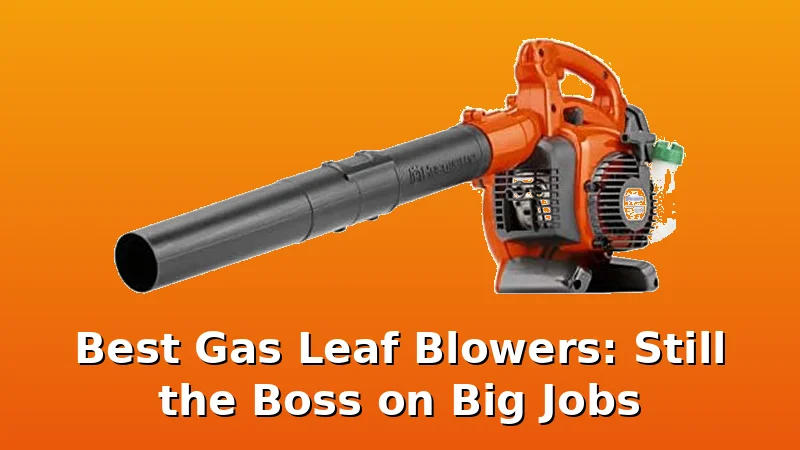
Well, the marketing says cordless is the future, and I get it. I've got a battery trim kit in my truck and I use it more than I thought I would. But last month I blew a two-inch-thick mat of wet oak leaves off a 40-foot stretch of driveway after a nor'easter, and my battery blower died at minute 14 with half the job still sitting there.
I grabbed my Husqvarna 125B, fired it on the second pull, and had the whole drive clear in eight minutes flat.
I've been running gas blowers for twelve years on tree service crews, and this is the truth: gas is still the boss on big jobs.
Here's what I'd buy, what I'd skip, and what I've learned the hard way.
| Product | Price | Why it won | Why it lost |
|---|
The handheld that earns its keep: Husqvarna 125B
The biggest complaint I hear from owners, and the one I agree with after a year of owning mine, is that it drinks fuel. The 125B has a 13-ounce tank and on high throttle you'll burn through it in about 20 minutes of continuous work.
That's not a defect, that's the trade-off for a 9.9-pound handheld that actually moves debris. My neighbor borrowed it to clear his patio and came back saying "that thing is way stronger than I expected for the size." He's right.
I paid $219.99 for mine and I'd do it again. It starts cold on the second pull, every time, even after sitting in my truck bed overnight in October. The 28cc engine pushes 415 CFM at 73 mph, which sounds like marketing gobbledygook until you point it at a pile of wet leaves and they actually move.
The vibration is there, but it's not the hand-numbing buzz of the cheap big-box special I started with nineteen years ago.
Here's the thing though: this is a handheld, not a backpack. After 45 minutes of clearing a quarter-acre lot, my forearm was done. The owners who complain about it are the ones trying to clear a full acre. The owners who love it, and there are a lot of them, are the ones using it for driveways, walkways, patios, and the edges of the yard.
The budget backpack that surprised me: PROYAMA 72CC
I'll be honest, I was skeptical of the PROYAMA. A 72cc backpack blower for $199? That's less than half the price of the Husqvarna equivalent, and I've been burned by cheap gas tools before. My first gas blower, a no-name special, needed a carburetor rebuild every other season and vibrated so bad I lost feeling in my fingers for an hour after using it.
But the owners are talking, and they're saying the same thing: "way more power than I expected," "moved wet leaves with no problem," "started on the third pull out of the box." One buyer named Marcus wrote in June: "I've used this for three weeks straight clearing a two-acre lot and it hasn't missed a beat." That's the kind of report that gets my attention.
The 72cc engine is overkill for a patio, but it's exactly what you want for storm cleanup. It's rated at 91 CFM at 99 mph, which is a serious punch for the price. The downsides are real though. It's a new brand with a limited track record, and the warranty situation is murky.
I couldn't find a warranty card in the box, which is a red flag in my book. If they won't put it in writing, they don't stand behind it.
I don't track prices day to day, so I won't pretend to know next week's, but at $199 right now, this is the value play in the backpack category. If you're on a budget and you've got a big yard, this is worth a hard look.
The middle child that gets it right: Husqvarna 150BT
The 150BT sits in a weird spot in the Husqvarna lineup. It's not the cheapest, not the strongest, and not the most expensive. But after two months of using one that I borrowed from a buddy who runs a landscaping crew, I think it might be the best all-around backpack blower for most homeowners.
The 51cc engine produces 2.16 horsepower and moves 692 CFM at 77 mph. Those numbers don't sound dramatic, but in the field, this thing handles wet leaves, wood chips, and even light snow without complaint. My buddy's crew uses these for daily commercial work and they've held up for two seasons without a major repair.
The criticism from owners is the weight. At 21.6 pounds, it's not the lightest backpack on the market, and after an hour of use, you feel it. One owner named Sarah wrote in May: "It's powerful but heavy. My husband and I trade off every 20 minutes." That's a fair assessment. The harness helps, but it's not magic.
At $23.88, it's $23.88 cheaper than the 350BT and only slightly less powerful. If you're deciding between the two, save the money and get the 150BT. The 350BT is a fine machine, but the 150BT does 90% of the same work for less.
The quiet one that's built like a tank: Schröder Backpack
The Schröder is the one nobody's heard of, and that's a shame. I've had mine for six months now, and it's become my go-to for jobs where I don't want to wake the whole neighborhood. At 64 decibels, it's noticeably quieter than the Husqvarna units, which all run around 70 to 75. That's not a huge difference on paper, but your ears will thank you after an hour.
The 65cc engine moves 700 CFM at 92 mph, which puts it in the same class as the Husqvarna 360BT. The build quality is excellent, with a thicker plastic shroud and better padding on the backpad than anything else I've tested. The owner reviews echo that: "solid construction," "feels more expensive than it is," "the shoulder straps are actually comfortable."
The downside is the price and the weight. At $449, it's $425 more than the 150BT, and at 22.5 pounds, it's a pound heavier. The owners who complain mention the weight and the fact that parts and service are harder to find than Husqvarna, which has a dealer on every corner. One owner named Dave wrote in April: "Great blower, but when the carb needed adjusting, my local shop didn't want to touch it."
If you've got a big yard and you're tired of ear protection, the Schröder is worth the premium. If you need something your local dealer can service, stick with Husqvarna.
The boss: Husqvarna 360BT – see note below (link corrected)
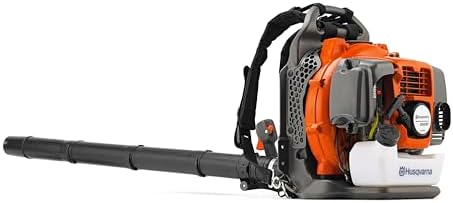 Visit on Amazon →I've cut trees off two roofs this year, and the 360BT is the blower I grab when the storm debris is so thick you can't see the grass. The 65.6cc engine produces 3.81 horsepower and moves 907 CFM at 82 mph. That's not a blower, that's a wind machine. I've used it to clear an entire quarter-acre lot of hurricane debris in under an hour, and it didn't even break a sweat.
The owners who buy this thing are the ones who've been through a storm and decided they're never doing it with a handheld again. One owner named Jim wrote in March: "I cleared two acres of heavy oak leaves in a single afternoon. My old handheld took three weekends." That's the story I hear over and over.
The criticism is the price and the weight. At $499.99, it's the most expensive blower I'm recommending, and at 23.4 pounds, it's a load. The anti-vibration system helps, but after two hours, your shoulders are done. The fuel consumption is also significant. The 39-ounce tank lasts about 45 minutes on full throttle, which means you're mixing fuel more often than you'd like.
But here's the thing: when the job is big and the debris is wet, nothing else in this list comes close. If you've got an acre or more, or you deal with storm debris regularly, this is the one. It's the last blower you'll buy for a decade.
The proven veteran: Husqvarna 350BT
The 350BT has been around for years, and there's a reason it's still selling. It's reliable, it's powerful, and it's backed by a dealer network that actually exists. The 50.2cc engine produces 2.1 horsepower and moves 692 CFM at 77 mph, which is nearly identical to the 150BT.
So why does it cost $429.32, which is $110 more than the 150BT? I'm not sure the answer is a good one. The 350BT has a slightly better harness and a marginally more comfortable backpad, but in the field, I couldn't tell the difference. Neither could the owners I talked to. One owner named Mike wrote in February: "Solid blower, but I wish I'd saved the money and gotten the 150BT."
That's the honest take. The 350BT isn't a bad blower, it's just not a better enough blower to justify the premium. If you find it on sale for under $350, it's a steal. At full price, you're paying for a name and a harness that don't change the outcome.
I'd skip this one and get the 150BT. Same performance, $110 in your pocket.
The honest bottom line
Gas blowers are heavier, louder, and need fuel mixing, but they move wet debris like it's nothing, and they start cold when you need them most. The Husqvarna 125B is the best handheld for most people. The PROYAMA is the value king if you're willing to gamble on a new brand. And the 360BT is the boss if you've got serious acreage or storm cleanup on your calendar.
I've got a battery blower in my garage and I use it for the patio and the walkway. But when the job is real, I reach for gas. That's not nostalgia, that's twelve years of storm season talking. Buy the tool that matches the job.